
Chemical @ IHS Laboratory (ChemLab).
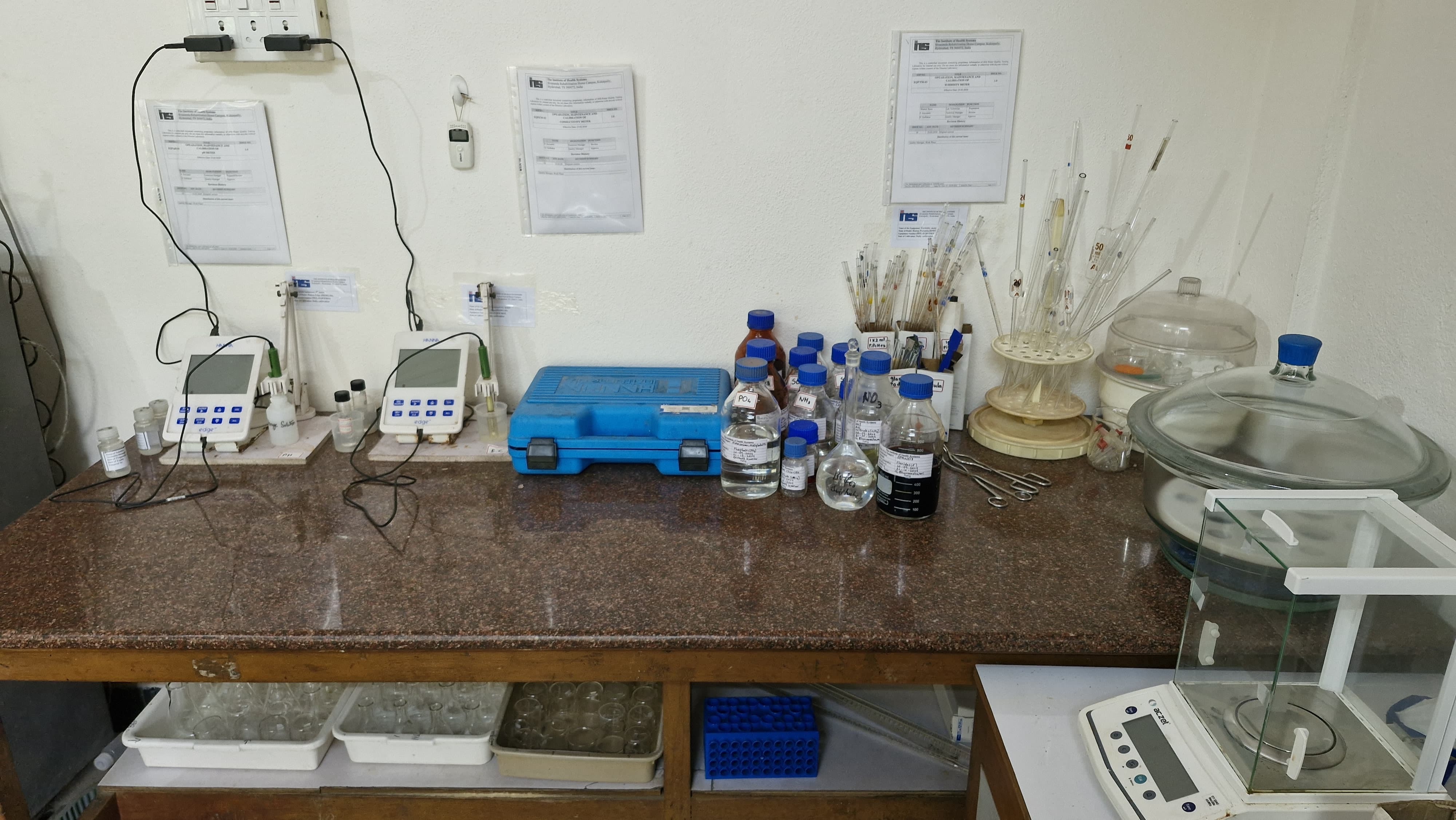
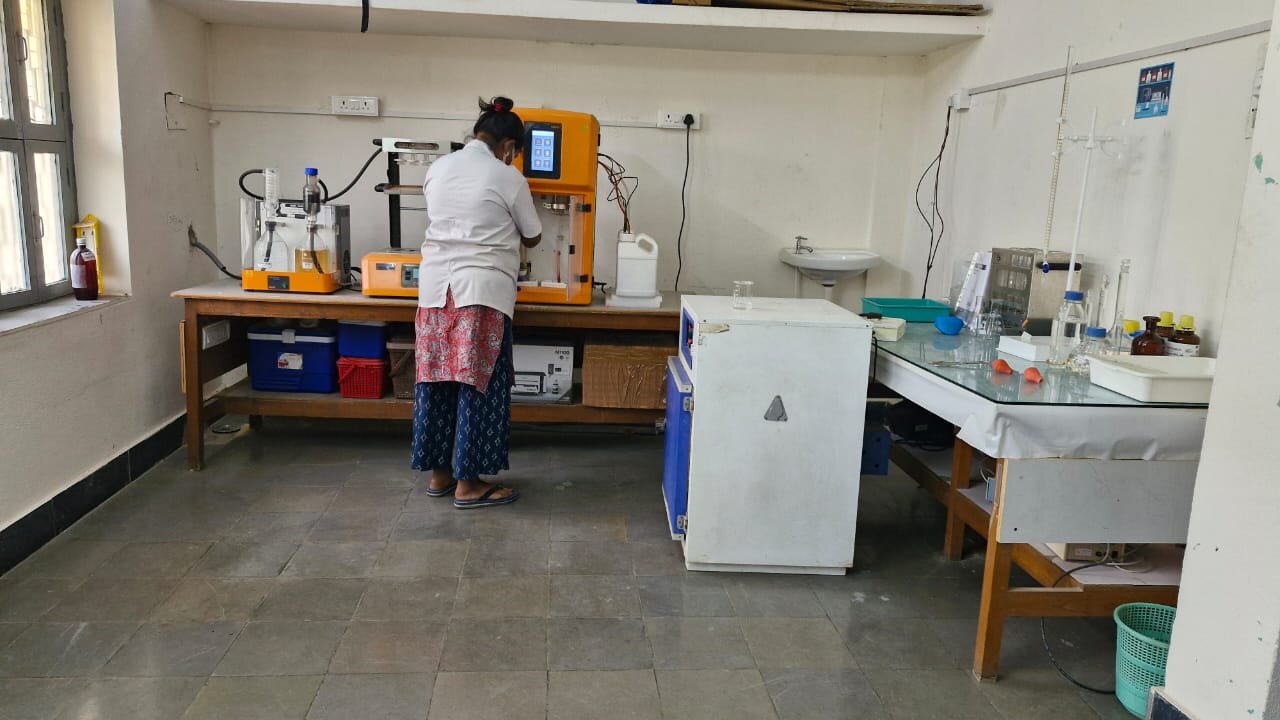
Physical Measurements Station
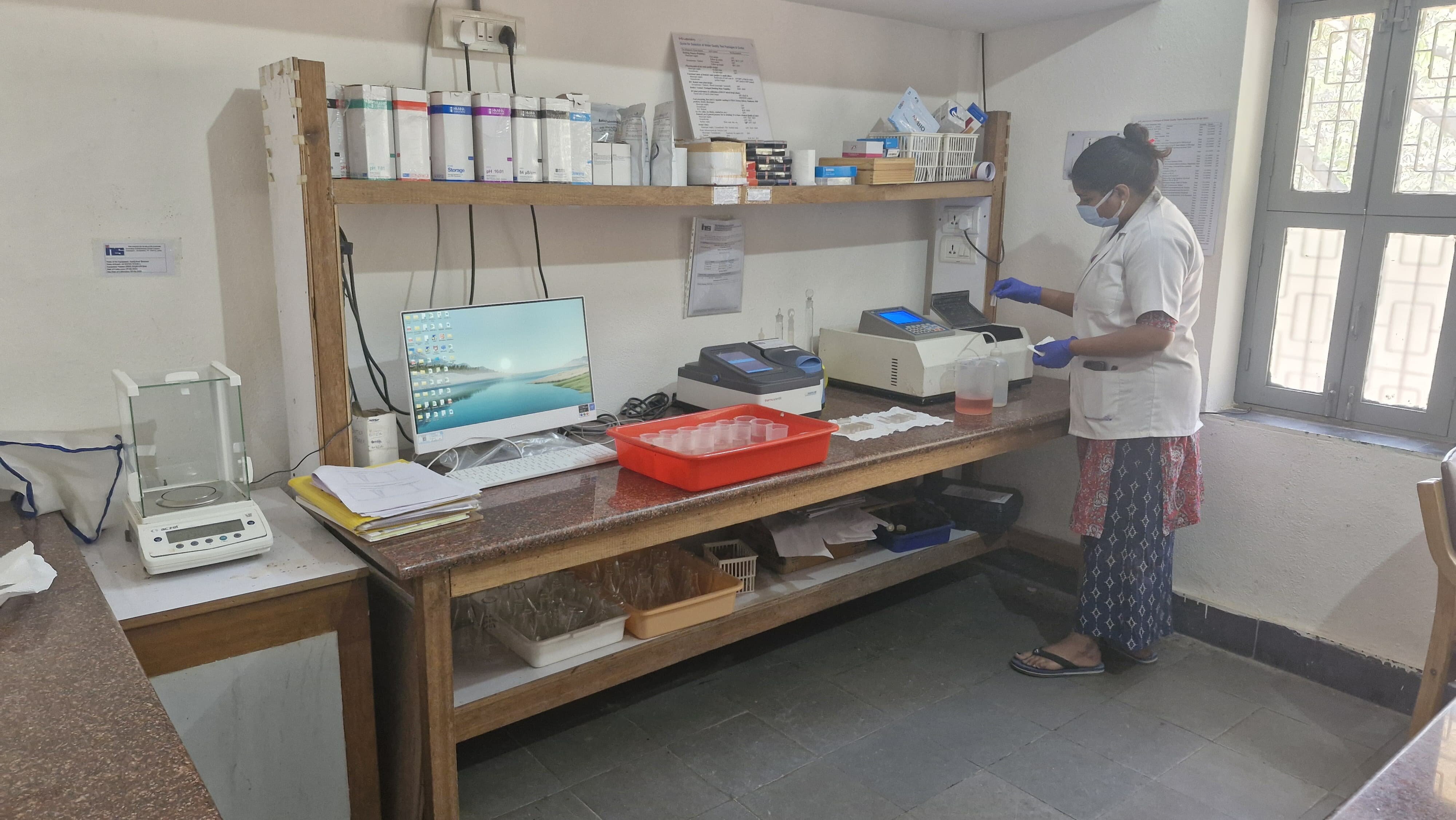
Spectrophotometry Station

Spectrophotometry In Progress
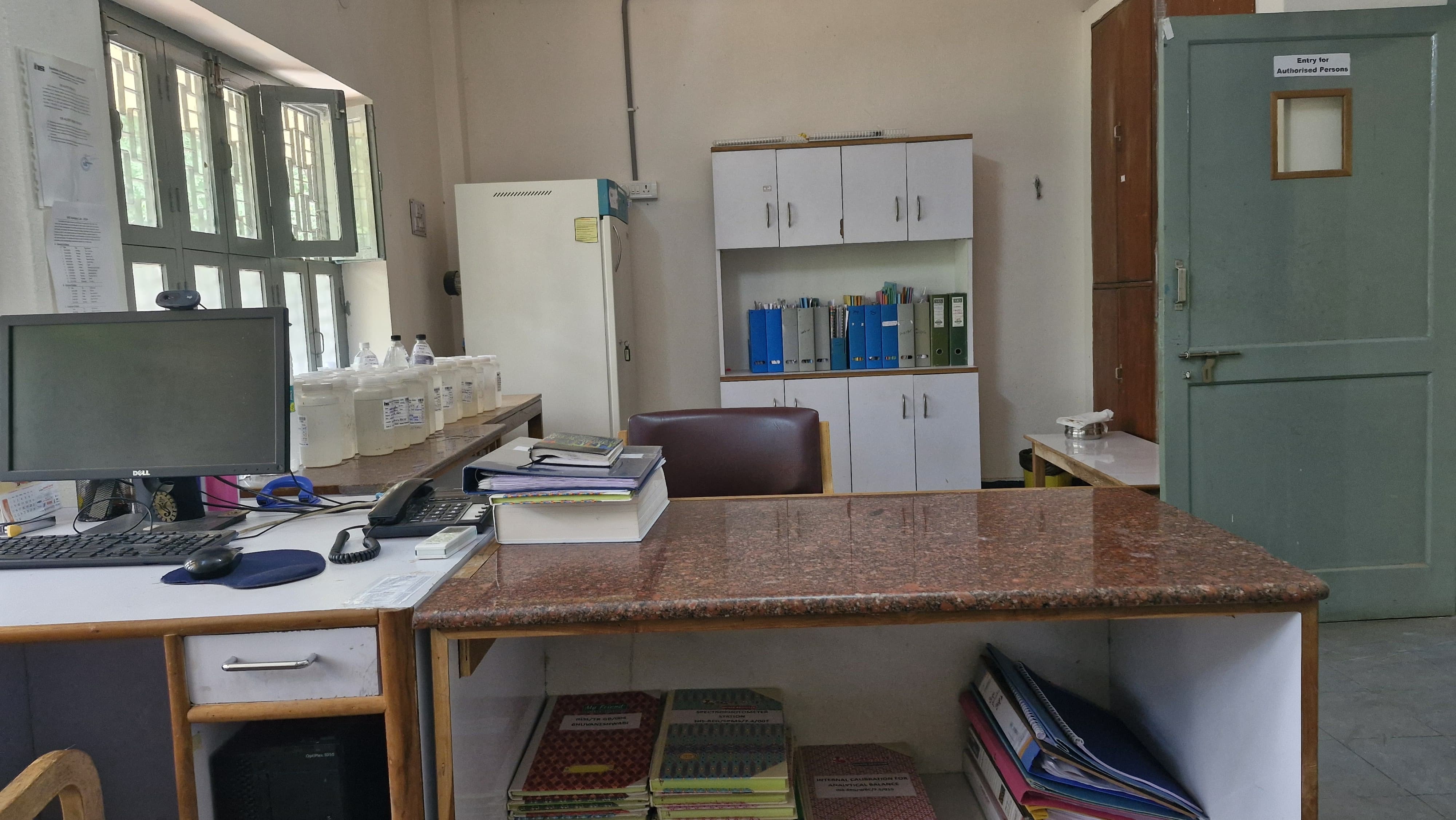
Sample Registration & Reporting Area
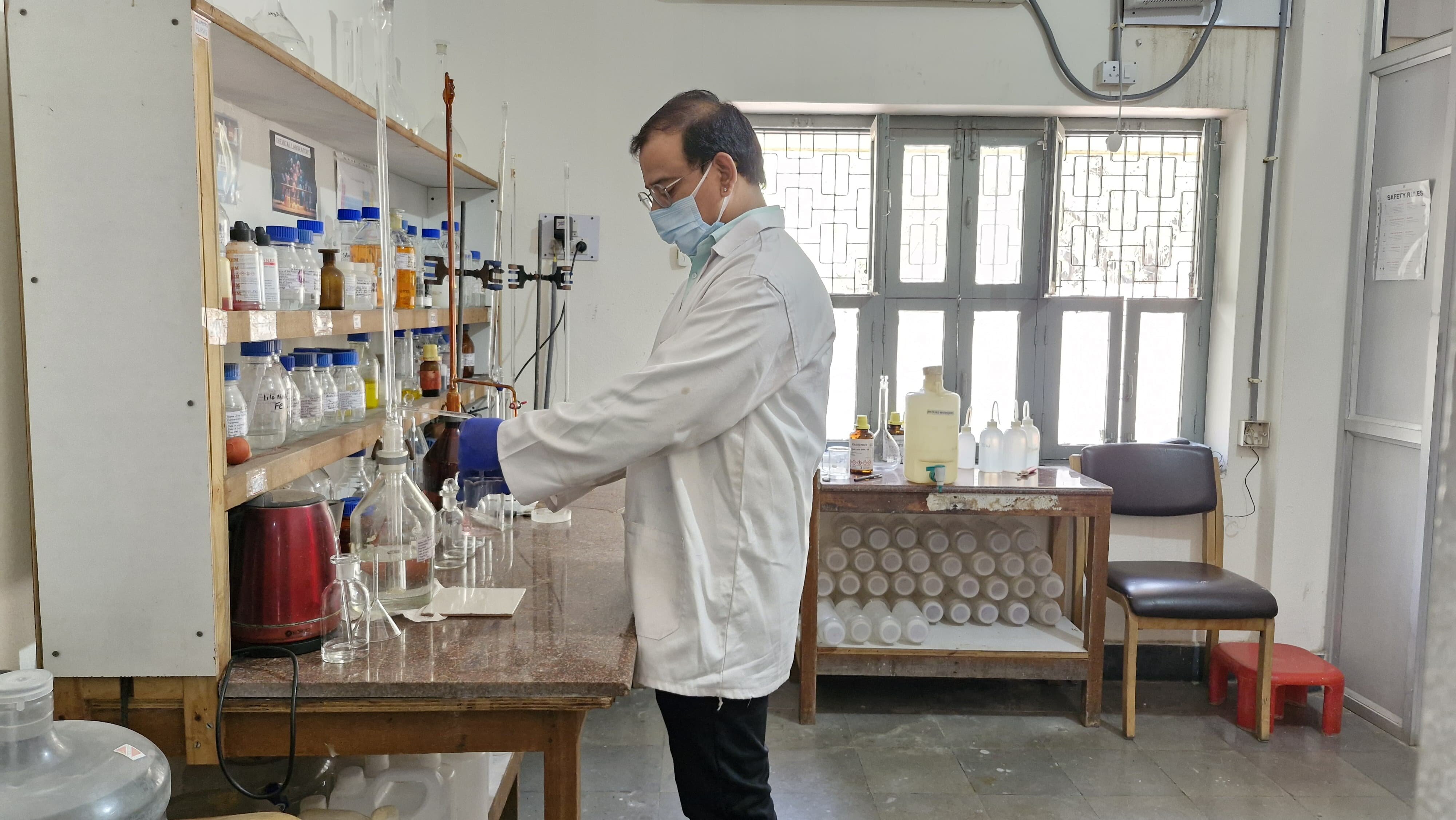
Titration Station-1
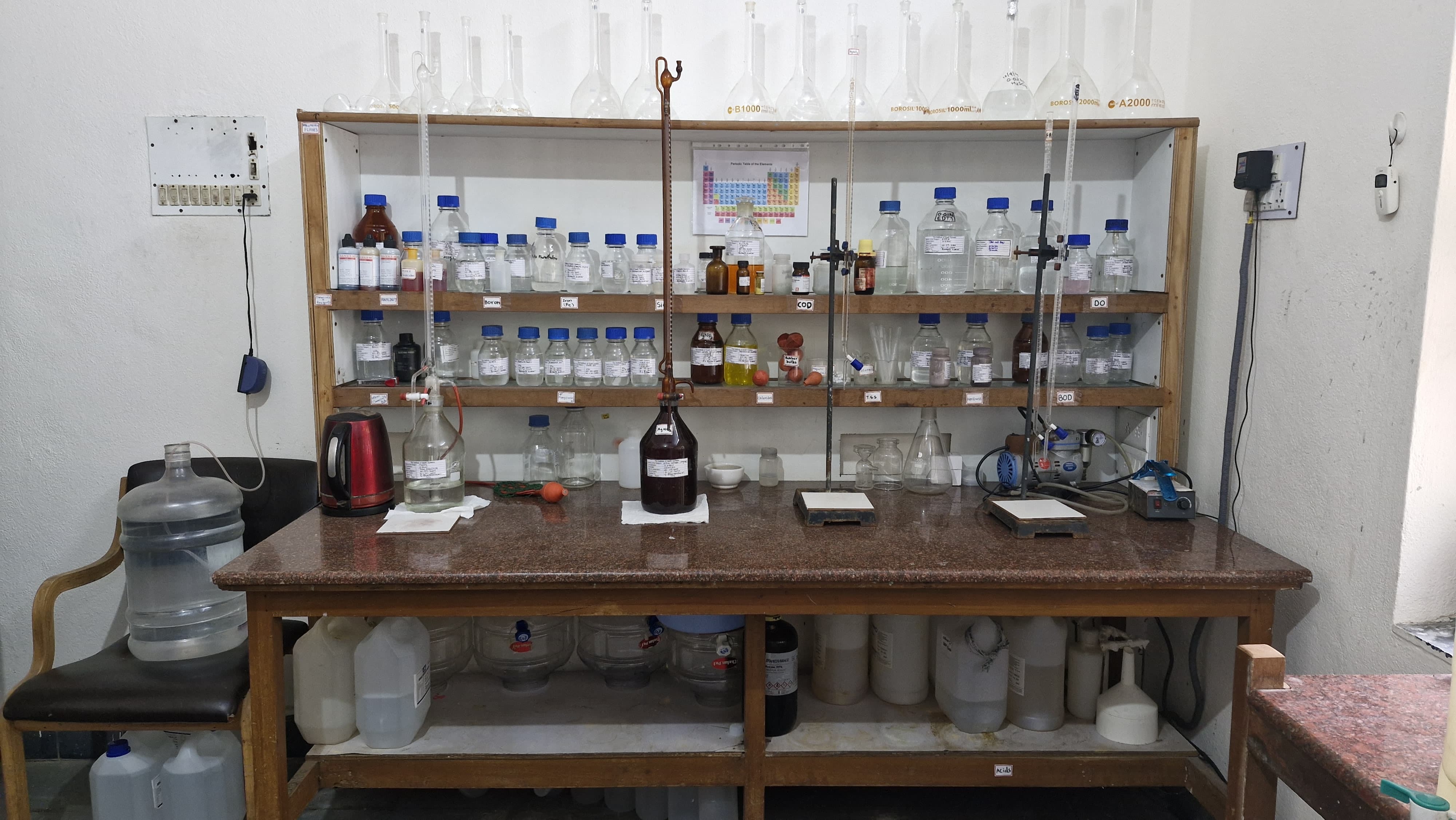
Titration In Progress
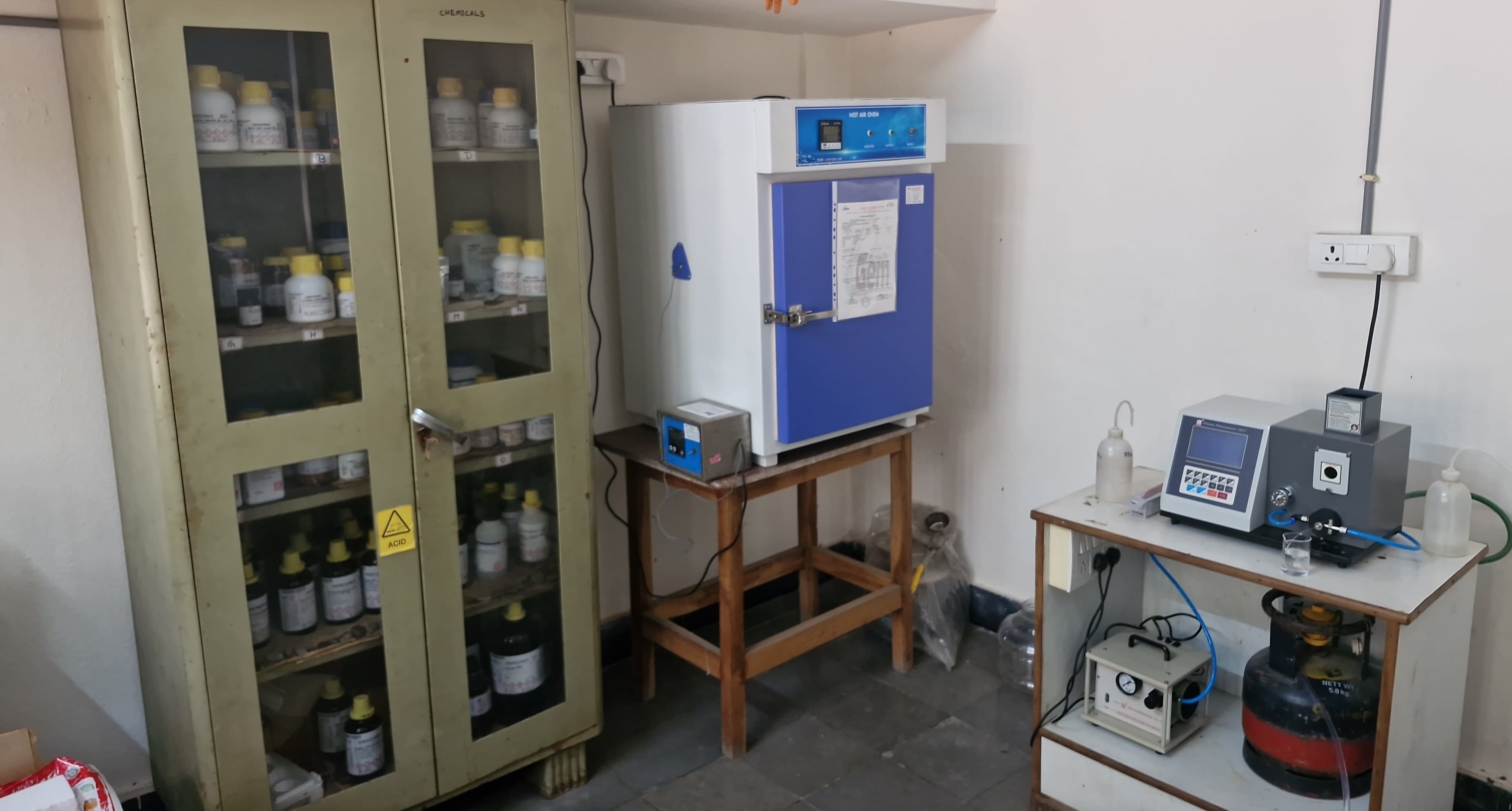
Hot-zone: Flame Photometry Station & Hot Air Oven.
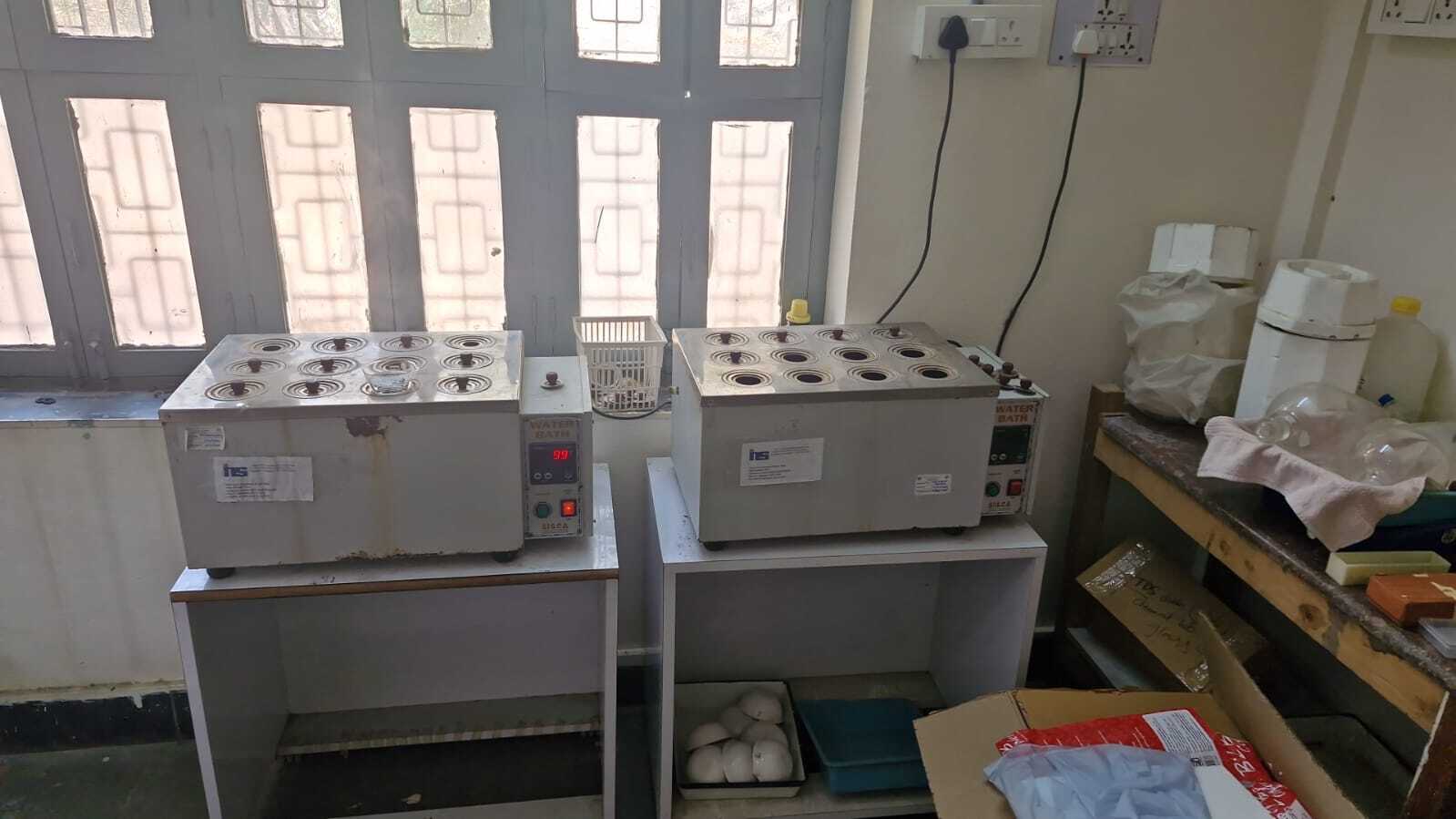
Hot-zone: Water Baths
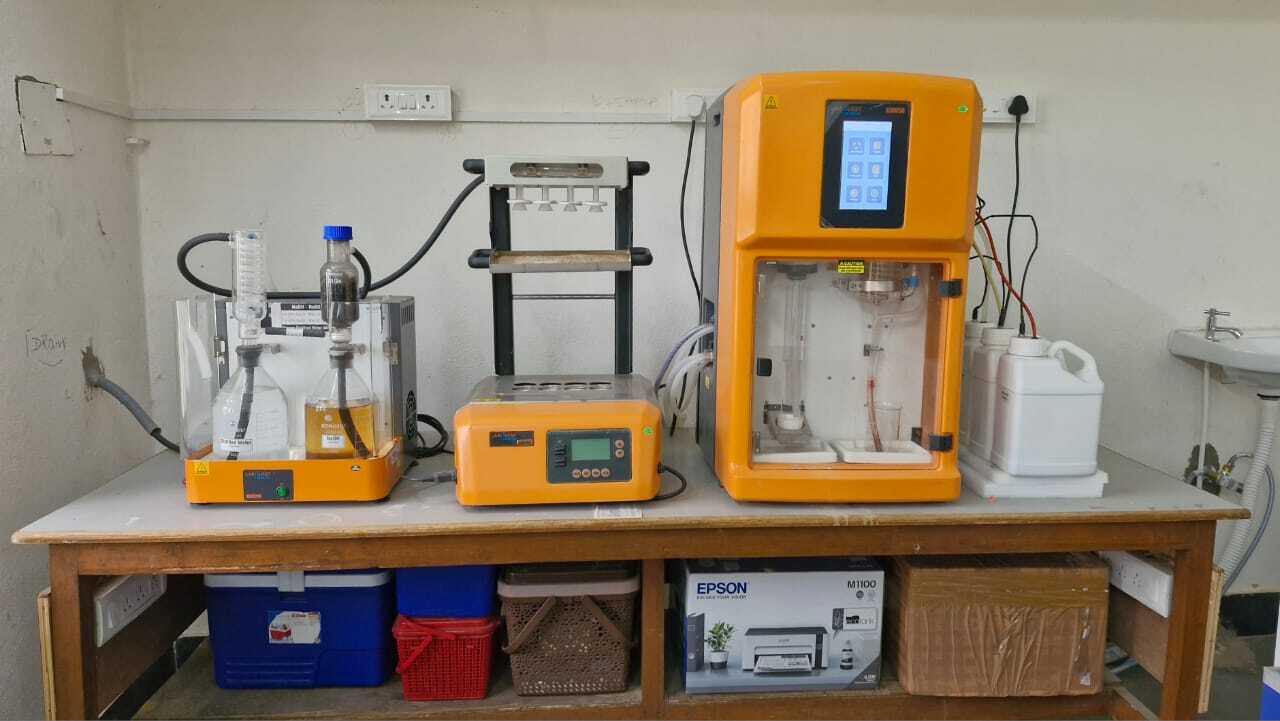
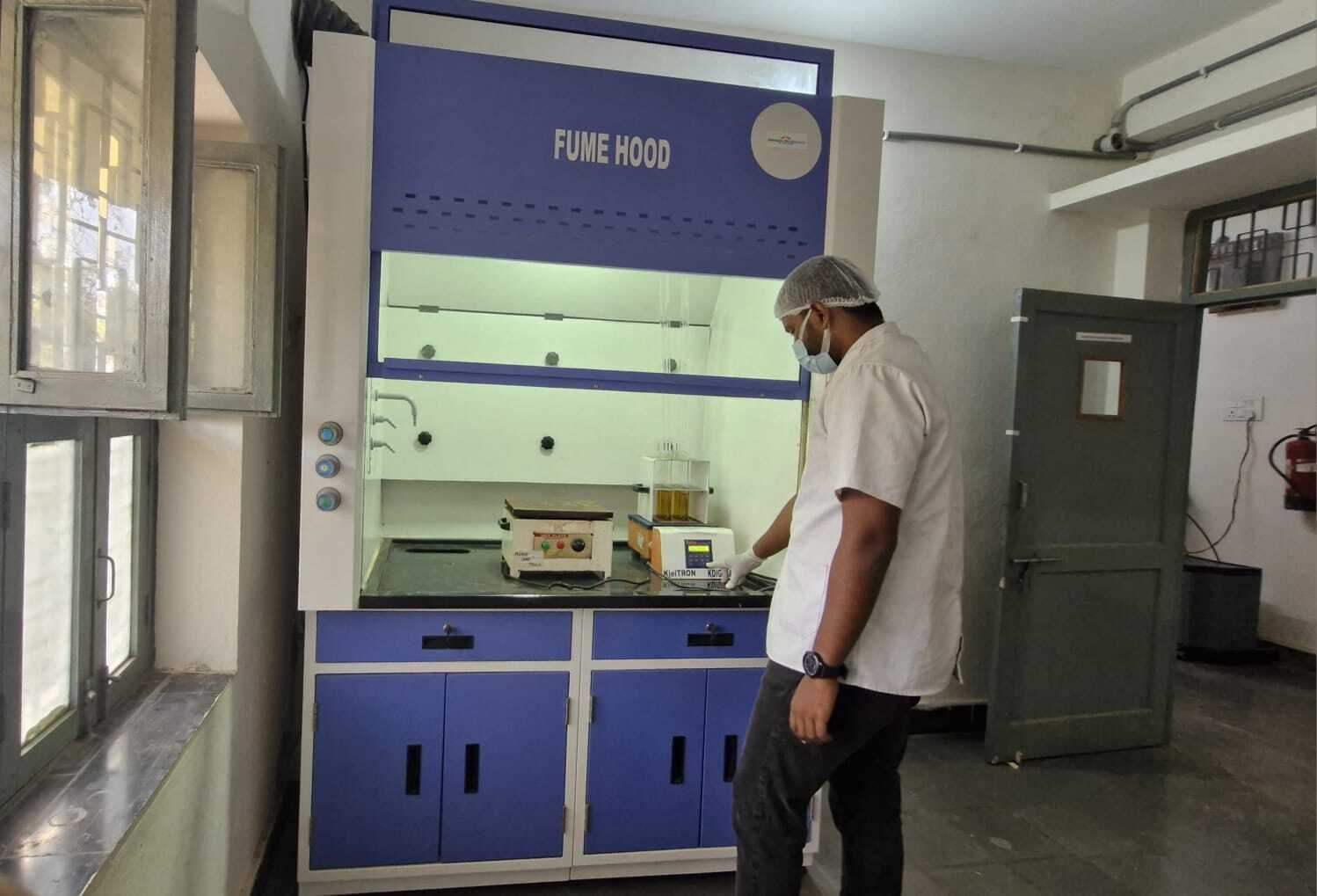
Kjeldahl Digestion Station
Wastewater Analysis Room
Fume Hood
The ChemLab is equipped to analyse and test for various physical and general chemical parameters in water from different sources.
The physical parameter station is equipped with nephelometer, pH meter, electrical conductivity meter, water baths, hot air oven, desiccator, analytical balance, suction pump, and filter assemblies. Sensory parameters such as odour and apparent colour are assessed by trained laboratory personnel. Occasionally, in case of doubt expanded smell panels are constituted by recruiting staff members from other areas of the Institute.
The titration station is equipped with Class A borosilicate volumetric glassware, including automatic burettes for manual titration. Volumetric glassware is calibrated periodically. NIST traceable laboratory reagents are used as titrants, for preparation of the analyte and as indicators. The laboratory is equipped for acid-base, redox, precipitation, and complexometric titrations.
The photometry station is equipped with visible and ultraviolet spectrophotometers. Standard solutions prepared from NIST traceable laboratory reagents are used to estimate standards curves. Absorptions and/or transmittance of light in appropriate wavelength of blanks and analytes helps in assuring validity of test results and estimation of parameter value from standard curves. The flame photometer is calibrated in every session with standard solutions.
The laboratory is equipped with digestor and incubator for estimation of chemical oxygen demand (COD) and biochemical oxygen demand (BOD).

The IHS Laboratory is accredited by the National Board of Accreditation for Testing and Calibration Laboratories (NABL) India.
Lab Id: T-4179; Certificate Number: TC-15240; Issue Date: 02-01-2025; Valid Until: 01-01-2029.
Scope of NABL Accreditation of the IHS Lab includes 264 test material & physical/chemical parameter combinations.
About 30 general and chemical parameters for testing of various types of water such as groundwater, surface water, drinking water, packaged drinking water, water from purifier, water for dialysis, purified water, irrigation water, swimming pool water, water for processed food industry, construction water, industrial water, and waste water are within the scope of NABL accreditation.
The IHS Laboratory is gradually developing itself as an easily accessible Public Health Laboratory for laboratory tests that are relevant to safeguarding and improvement of people’s health. Keeping with this objective, new test services are introduced to meet felt needs. The IHSL follows sound quality assurance mechanisms and adopts standard test methods for all tests including newly introduced tests. However, immediate accreditation by NABL may not be feasible, for various reasons. Thus, at any point of time, the laboratory would have a set of NABL accredited parameters, and other parameters for which NABL accreditation is not yet available. To avoid any misrepresentation, the IHSL we adopt a strict policy of using NABL symbol in test reports only if all test results included in the report are within the scope the accreditation. For more details see;
The IHSL Policy for Use of NABL Symbol and Claim of NABL Accreditation on Test Reports.
ChemLab - Scope of Service
Test Parameters Accredited by NABL
| Sl | SvCd | Parameter | Test Material | Test Method in Brief |
|---|---|---|---|---|
| APP | Apparent Colour | Drinking Water, Wastewater. | IS 3025 (Part 4) - 2021, 4.7.1 Apparent colour. Observed colour of unfiltered sample i.e. before removal of turbidity. | |
| CLR | Colour | Drinking Water, Groundwater, Surface Water, Water from Purifiers, Packaged Drinking Water, Water for Food Processing, Swimming Pool Water, Irrigation Water, Industrial Water. | IS 3025 (Part 4) - 2021 True color. Visual comparison with standard chloroplatinate solution. Step-0, Preparation & Maintenance of Standard: (a) Prepare 1, 2, 5, 10, 15, 20, 25, 30, 40, 50, 60 & 100 CU standards by dilution from; (a) prepared standard chloroplatinate stock solution, OR (b) ready to use APHA / Hazen Platinum-cobalt Color Standard solutions. Transfer to 12-hole Nessler Tube Stand arranged in increasing order of CUs and labelled as such, for use as standards. If 12-hole stand is not available, use two 6-hole Nessler Tube Stands; Stand-1 for CU 1 to 15 & Stand-2 for CU 20 to 100. Protect the Nessler tubes using clean inert caps/stoppers/foil and keep in dark and away from sources of ammonia, when not in use. Prepare fresh standards, every month, from stock solution. Step-1, Sample Preparation: If pH is outside range of 4 to 10, adjust pH to about 7.0 and note the adjustment. Filter about 50 ml sample through 0.45µm (micron) cellulose membrane or glass fiber filter. Compare filtrate with distilled water to ensure that turbidity had been removed. Step-2, Visual Comparison: Take the filtered sample in a Nessler tube and match with standard CU tubes to read result. | |
| ODR | Odour | Drinking Water, Groundwater, Surface Water, Water from Purifiers, Packaged Drinking Water, Water for Food Processing, Swimming Pool Water, Irrigation Water, Industrial Water, Construction Water. | IS 3025 (Part 5) - 2018 Odour. Observation by lab personnel and in case of doubt by an expanded smell panel. Report true odour for e.g., chlorinous, stale, soapy, earthy, foul, rotten egg, sewage, drainage, burnt sugar, aromatic, perfume, medicinal, phenyl, turpentine, solvent, petroleum, kerosene, or any other specific odour. If exact nature of odour cannot be identified, report as agreeable or disagreeable. | |
| NTU | Turbidity | Drinking Water, Groundwater, Surface Water, Water from Purifiers, Packaged Drinking Water, Water for Food Processing, Swimming Pool Water, Irrigation Water. | IS 3025 (Part 10) - 2023 Turbidity, by Nephelometry. Memory aid: Water with a turbidity of less than 15 NTU typically appears clear. Water with a turbidity of 15 to 30 NTU appears noticeably cloudy or hazy. Water with a turbidity of ≥ 40 NTU appears distinctly cloudy, murky, or muddy to the naked eye. Prep-1, Calibration: Calibrate nephelometer/turbidimeter using secondary formazine standard procured from instrument manufacturer (preferable) or commercial suspension of turbidity standard, as per procedure in the instruction manual. Prep-2, Clean sample cells: Keep sample cells / cuvettes scrupulously clean, both inside and out. Discard scratched or etched samples cells/cuvettes. Step-1, If murky, dilute sample: Dilute distinctly murky/muddy samples, with double deionised water, to measure turbidity > 40NTU, then step-2. Step-2, Nephelometry: Gently shake sample to disperse solids. Wait until air bubbles disappear. Pour sample into clear two-side cuvette/cell and read NTUs from the Turbidimeter/Nephelometer. Reporting: ≤ 1 NTU: 2 decimal places; ≤ 10 NTU: 1 decimal place; 10-40NTU: integer only; 40-100 NTU: Round to nearest 5NTU; 100-400 NTU: Round to nearest 10 NTU; 400-1000 NTU: Round to nearest 50; >1000 NTU: Round to nearest 100. LOD: 0.033 NTU; LOQ: 0.1 NTU. Instrument accuracy: ± 2% of reading + 0.02 NTU; Measurement Uncertainty (Repeatability): 0.02NTU. |
|
| PHV | pH value | Drinking Water, Groundwater, Surface Water, Water from Purifiers, Packaged Drinking Water, Water for Food Processing, Swimming Pool Water, Irrigation Water, Industrial Water, Construction Water, Wastewater. | IS 3025 (Part 11) - 2022 / ISO 10523 - 2008: Electrometric method, pH at 25℃. Measure by pH meter with built-in temperature sensing and auto correction. Set-up to "Basic Mode" for pH. Calibrate at ≥3-points, with standard buffer solutions and following procedure in the instruction manual. Rinse electrode with distilled/deionised water, before each measurement. If feasible, plan for pH measurement first, and insert electrode directly into the sample bottle. Otherwise, pour a portion of sample into a small plastic beaker and immerse pH electrode fully but not touching the bottom. Gently stir the sample with a probe and press "measure". Wait till stable reading is achieved. In case of doubt, repeat the rinse and measure process until succesive sample readings are within 0.1 pH unit of each other. [Notes: During operation hours, rest electrode in a beaker containing electrode cleaning solution. After operation hours, rinse the electrode in cleaning solution and store in a container with pH storage solution.] | |
| ECS | Electrical Conductivity aka Specific Conductance | Drinking Water, Groundwater, Surface Water, Water from Purifiers, Packaged Drinking Water, Water for Food Processing, Swimming Pool Water, Irrigation Water, Industrial Water, Wastewater. | IS 3025 (Part 14) - 2013, RA 2023: Measure by conductivity meter with four-ring potentiometric probe & built-in temperature sensor. Make sure the instrument is set-up to "Basic Mode" for EC and the the probe is configured to automatic temperature compensation and reference temperature is set to 25°C and EC range is set to "Auto". Calibrate the instrument with with KCl standard solutions, as per the instruction manual. Pour sample in plastic beaker. Rinse the probe in distilled/deionised water and suspend it in the sample, allowing at least one inch gap from the sides & bottom of the container. Read result and note displayed unit of measurement. Caution! The instrument automatically switches the unit of measurement from µS (micro Siements) to mS (milli Siemens), based on measured condutivity. Range of Testing: 1 µ Siemens (S) to 10,000 µ Siemens(S). | |
| TDSG | Total Dissolved Solids | Drinking Water, Groundwater, Surface Water, Water from Purifiers, Packaged Drinking Water, Water for Food Processing, Irrigation Water, Industrial Water, Wastewater. | IS 3025 (Part 16) - 2023. Gravimetry: Filtered sample is evaporated in a tared dish on water-bath and residue is dried at 180℃ ± 2℃ to constant mass. LOD: 1.3 mg/L; LOQ: 4.0 mg/L. [Note: Drying for 1 h to 2 h eliminates necessity of checking for constant mass.] | |
| TSS | Total Suspended Solids | Drinking Water, Groundwater, Surface Water, Water from Purifiers, Packaged Drinking Water, Water for Food Processing, Swimming Pool Water, Irrigation Water, Industrial Water, Construction Water, Wastewater. | APHA Standard Methods 24th Ed. 2540-D Vacuum filtration of measured volume through 1.6µm dia:47mm glass fibre filter, dried at 105°C, cool in desiccator and weigh. LOD: 1.3 mg/L; LOQ: 4.0 mg/L. [Note: The filtrate from the TSS experiment can be used to measure TDS.] | |
| TSC | Total Solid Components | Total Dissolved Solids by Gravimetry + Total Suspended Solids. | ||
| TSD | Total Solids, Dried at 104±1°C. | Drinking Water, Wastewater. | APHA Standard Methods 24th Ed. 2540-B Total Solids Dried from 103 to 105°C. Heat clean evaporating dish at 104±1°C for ≥1h, cool to ambient temperature and store in desiccator/oven, until needed. Determine sample volume to yield between 2.5 and 200mg dried residue. Evaporate measured volume of sample in a prewieghed dish using steam bath, hot plate or drying oven. Adjust temperature to avoid splattering. Dry the evaporated sample at 104±1°C for ≥1h. Cool the dish in a desiccator to ambient temperature and weigh. Repeat the drying for ≥1h, colling, desiccating, and weighing cycle until weigh change is <0.5 mg. LOD: 0.66 mg/L; LOQ: 2.0 mg/L. | |
| FACL | Free Available Chlorine aka Free Residual Chlorine. | Drinking Water, Water from Purifiers, Water for Food Processing. | APHA Standard Methods 24th Ed. 4500-Cl G. DPD Colorimetric method. Photometric measurement by Chlorine Colorimeter, using DPD, 1A & 1B free chlorine reagent solutions (liquid kit) or instrument grade tablets and follow steps in colorimeter quick guide or refer the user manual, as required. LOD: 0.01 mg/L; LOQ: 0.03 mg/L. | |
| TCL | Total Chlorine | Drinking Water, Water from Purifiers, Water for Food Processing, Swimming Pool Water, Water for Medicinal Purposes. | APHA Standard Methods 24th Ed. 4500-Cl G. DPD Colorimetric method. Photometric measurement by Chlorine Colorimeter, using DPD 3 total chlorine reagent solution (liquid kit) or instrument grade tablet and follow steps in colorimeter quick guide or refer the user manual, as required. LOD: 0.01 mg/L; LOQ: 0.03 mg/L. | |
| FRCV | Free Residual Chlorine by Visual comparison. | Live Municipal Water Supply, Water from Municipal Water Distribution Service Reservoirs, Drinking Water, Water from Purifiers, Water for Food Processing. | DPD visual comparison method: First, rinse the test tube with the water to be tested. Then, refill the tube up to 5 ml mark. Position the DPD 1R tablet blister strip on top of the test tube and press from other side to release a tablet directly from the blister pack, into the tube. Wait till the tablet dissolves completely. Read result immediately after the tablet is dossolved. If RC is present, colour of test-sample turns to a shade of red depending on the level of free chlorine. Measure strength of colour against standard colours on the visual comparison chart to determine the chlorine concentration. The stronger the colour, the higher the concentration of chlorine in the water. | |
| PALK | Phenolphthalein Alkalinity aka P Alkalinity | Drinking Water, Groundwater, Surface Water, Water from Purifiers, Packaged Drinking Water, Water for Food Processing, Swimming Pool Water, Irrigation Water, Industrial Water, Construction Water. | IS 3025 (Part 23) - 2023, colour indicator and/or potentiometric titration: Prep-1: Prepare alkalinity standard from CRM Na2CO3 following SOP for preparation of alkalinity standards. Prep-2: Prepare required volume of uncalibrated ≈0.02N H2SO4 solution by diluting 100 ml of ≈0.2N H2SO4 to 1L double distilled (DD) water. Calculate required volume according to workload for one month or less. Prep-3: Calibrate the ≈0.2N H2SO4 following SOP for calibration of sulfuric acid titrant. Step-0: Do not filter, dilute, concentrate, or alter the sample. If required, dechlorinate sample with 1-drop of 0.1N Na2S2O3. Step-1: Ascertain or check sample pH. If pH < 8.3, report P-Alk=0. Step-2 pH ≥ 8.3: Clear samples: Titrate with calibrated 0.02N standard H2SO4, using phenolphthalein indicator. As the end point is approached, proceed with dropwise addition of titrant. Computation & Reporting of Results: Report P-Alk as mg/L CaCO3 = [(A × N × 50,000) / Volume of Sample in ml] where A = ml of titrant consumed and N = calibrated Normality of titrant (H2SO4). Coloured or turbid samples: Titrate using a potentiometer instead of indicators. LOD: 3.9 mg/L; LOQ: 12.8 mg/L. | |
| MALK | M -Alkalinity | Drinking Water, Groundwater, Surface Water, Water from Purifiers, Packaged Drinking Water, Water for Food Processing, Swimming Pool Water, Irrigation Water, Industrial Water, Construction Water, Wastewater. | IS 3025 (Part 23) - 2023, colour indicator and/or potentiometric titration:
Prep-1: Prepare alkalinity standard from CRM Na2CO3 following SOP for preparation of alkalinity standards.
Prep-2: Prepare required volume of uncalibrated ≈0.02N H2SO4 solution by diluting 100 ml of ≈0.2N H2SO4 to 1L double distilled (DD) water. Calculate required volume according to workload for one month or less.
Prep-3: Calibrate the ≈0.2N H2SO4 following SOP for calibration of sulfuric acid titrant.
Standard allkalinity method, for Alk ≥ 20mg/L: Clear samples: Do not filter, dilute, concentrate, or alter the sample. Take 20 ml sample in a beaker. If required, dechlorinate sample with 1-drop of 0.1N Na2S2O3. If pH>8.3, titrate for P-alk first. Then titrate with calibrated 0.02N standard H2SO4, using mixed indicator. As the end point is approached, proceed with dropwise addition of titrant. Computation & Reporting of Results: Report T-Alk as mg/L CaCO3 = [((A+B) × N × 50,000) / Volume of Sample in ml] where A = ml of titrant consumed for P-Alk, B = ml of titrant consumed for M-Alk, and N = Normality of titrant (H2SO4). If, T-Alk ≥500 mg/L as CaCO3, dilute the sample and repeat test. Coloured or turbid samples: Titrate using a potentiometer instead of indicators. Low-alkalinity method: For alkalinity < 20 mg/L, titrate at least 100 ml sample with 0.02N standard H2SO4 OR titrate at least 50 ml sample with 0.01N standard H2SO4. And, if required, adopt drop titration using precision dispenser, micro burette or precalibrated dropper with known volume per drop. LOD: 3.9 mg/L; LOQ: 12.8 mg/L. |
|
| ALK | Total Alkalinity P-Alkalinity + M -Alkalinity | Drinking Water, Groundwater, Surface Water, Water from Purifiers, Packaged Drinking Water, Water for Food Processing, Swimming Pool Water, Irrigation Water, Industrial Water, Construction Water, Wastewater. | IS 3025 (Part 23) - 2023, colour indicator and/or potentiometric titration:
Prep-1: Prepare alkalinity standard from CRM Na2CO3 following SOP for preparation of alkalinity standards.
Prep-2: Prepare required volume of uncalibrated ≈0.02N H2SO4 solution by diluting 100 ml of ≈0.2N H2SO4 to 1L double distilled (DD) water. Calculate required volume according to workload for one month or less.
Prep-3: Calibrate the ≈0.2N H2SO4 following SOP for calibration of sulfuric acid titrant.
Standard allkalinity method, for Alk ≥ 20mg/L: Clear samples: Do not filter, dilute, concentrate, or alter the sample. Take 20 ml sample in a beaker. If required, dechlorinate sample with 1-drop of 0.1N Na2S2O3. If pH>8.3, titrate for P-alk first. Then titrate with calibrated 0.02N standard H2SO4, using mixed indicator. As the end point is approached, proceed with dropwise addition of titrant. Computation & Reporting of Results: Report T-Alk as mg/L CaCO3 = [((A+B) × N × 50,000) / Volume of Sample in ml] where A = ml of titrant consumed for P-Alk, B = ml of titrant consumed for M-Alk, and N = Normality of titrant (H2SO4). If, T-Alk ≥500 mg/L as CaCO3, dilute the sample and repeat test. Coloured or turbid samples: Titrate using a potentiometer instead of indicators. Low-alkalinity method: For alkalinity < 20 mg/L, titrate at least 100 ml sample with 0.02N standard H2SO4 OR titrate at least 50 ml sample with 0.01N standard H2SO4. And, if required, adopt drop titration uisng precision dispenser, micro burette or precalibrated dropper with known volume per drop. LOD: 3.9 mg/L; LOQ: 12.8 mg/L. |
|
| ACD | Acidity | Construction Water | IS 3025 (Part 22) - 2024: Color Indicator & Potentiometric Titration: Use CO2-free distilled water to prepare all reagents. If required, pretreat acidified (pH≤4.0) sample by adding H2O2 and boiling for 2 min. Titrate by adding slowly 0.02N NaOH up to pH=8.3, using phenolphthalein indicator, for acidity at 8.3pH. For samples with pH<3.7, titrate to pH=3.7, using methyl orange as indicator. LOD: 0.5 mg/L; LOQ: 5.0 mg/L. | |
| TWH | Total Water Hardness | Drinking Water, Groundwater, Surface Water, Water from Purifiers, Packaged Drinking Water, Water for Food Processing, Swimming Pool Water, Irrigation Water, Industrial Water, Wastewater. | IS 3025 (Part 21) - 2009, RA 2023, EDTA method. Complexometric titration (chelatometry) of measured water sample in alkaline buffer (pH ≅10) with standard EDTA solution (complexing agent); using EBT as indicator. Pretreatment of wastewater and highly polluted water samples with HNO3 digestion: Digest measured aliquot of the sample with 3 ml conc. HNO3 on hot plate, avoid boiling, and evaporate to near dryness. Repeat digestion with HNO3 till digestate is light in colour. Add 5 ml 1:1 HCl and warm to dissolve residue. Cool and make up to initial volume and proceed with complexometric titration. Water with low hardness ≤5 mg/L: Use microburette and increase sample volume. LOD: 5.0 mg/L; LOQ: mg/L. | |
| CAH | Calcium Hardness as CaCO3 mg/L | Drinking Water, Groundwater, Surface Water, Water from Purifiers, Packaged Drinking Water, Water for Food Processing, Water for Medicinal Purposes, Swimming Pool Water, Irrigation Water, Industrial Water, Construction Water, Wastewater. | IS 3025 (Part 40) : 2024, sec 5: Complexometric titration of strongly alkalized sample (pH: 12 to 13) with EDTA; using P&R reagent as indicator. If alkalinity ≤ 300mg/L take 50 ml sample, else take 25 ml & dilute to 50ml, in a beaker. Add 2.0ml NaOH solution to adjust 12≥ pH ≤13. Add a pinch of P&R indicator mixture and immediately titrate with standard EDTA. Confirm end-point by adding 1-2 drops of titrant in excess to ensure, there is no further colour change. Calcium hardness (as CaCO3), mg/L = [(A × B × 1000) ÷ V]; Where A = volume in ml of EDTA solution used to reach titration end-point, B = mass, in mg, of Ca equivalent ot 1 ml EDTA solution, and V = sample volume, in ml, taken for the test. LOD: 0.5 mg/L; LOQ: 5.0 mg/L. Conversion of Calcium Hardness to Calcium: CAH as CaCO3 × 0.4004 mg/L = Ca2+ mg/L. | |
| CLC | Calcium as Ca2+ mg/L | Drinking Water, Groundwater, Surface Water, Water from Purifiers, Packaged Drinking Water, Water for Food Processing, Water for Medicinal Purposes, Swimming Pool Water, Irrigation Water, Industrial Water, Construction Water, Wastewater. | IS 3025 (Part 40) : 2024, sec 5: Complexometric titration of strongly alkalized sample (pH: 12 to 13) with EDTA; using P&R reagent as indicator. If alkalinity ≤ 300mg/L take 50 ml sample, else take 25 ml & dilute to 50ml, in a beaker. Add 2.0ml NaOH solution to adjust 12≥ pH ≤13. Add a pinch of P&R indicator mixture and immediately titrate with standard EDTA. Confirm end-point by adding 1-2 drops of titrant in excess to ensure, there is no further colour change. Calcium hardness (as CaCO3), mg/L = [(A × B × 400.8) ÷ V]; Where A = volume in ml of EDTA solution used to reach titration end-point, B = mass, in mg, of Ca equivalent to 1 ml EDTA solution, and V = sample volume, in ml, taken for the test. LOD: 0.05 mg/L; LOQ: 2.0 mg/L. Conversion (mg to meq): 0.0499 × Ca2+ mg/L) | |
| MGM | Magnesium as Mg2+ mg/L | Drinking Water, Groundwater, Surface Water, Water from Purifiers, Packaged Drinking Water, Water for Food Processing, Water for Medicinal Purposes, Swimming Pool Water, Irrigation Water, Industrial Water, Wastewater. | IS 3025 (Part 46) : 2024, sec 6: Volumetric method. Determine total (Ca & Mg) hardness by complexometric titration of alkalized sample (pH ≅10) with EDTA; using EBT indicator. Determine calcium hardness by complexometric titration of strongly alkalized sample (pH: 12 to 13) with EDTA; using P&R indicator. Mg hardness = Total hardness - Calcium hardness (all expressed as CaCO3). Magnesium as Mg2+ mg/L = 0.2439 × Mg hardness as CaCO3 mg/L. LOD: 0.05 mg/L; LOQ: 2.0 mg/L. Conversion (mg to meq): 0.082293 × Mg2+ mg/L) | |
| NH3T | Ammoniacal Nitrogen (NH3-N) by Titration | Drinking Water, Groundwater, Surface Water, Water from Purifiers, Water for Food Processing, Swimming Pool Water, Irrigation Water, Industrial Water, Wastewater. |
IS 3025 (Part 34/Sec 1):2023, 5.3 Titrimetric Method using Rapid Steam Distillation (RSD)Apparatus.
Step-1, Sample Preparation: Steam out distillation apparatus using alkalinized borate buffer solution as in clause 5.2.1. Select sample volume (V). If V≤100ml, use 250 Kjeldahl distillation tube. Else, use 400 ml tube. If RC>0, add 1-drop of 0.1N Na2S2O3 to dechlorinate. Step-2, Distillation: Add 25 ml borate buffer solution, then 6 N NaOH until pH=9.5. Add a few glass beads. Dilute with ammonia free water as required. Distill in RSD Apparatus. Collect distillate in conical flask containing 50 ml indicating boric acid solution, as the absorbent (ammonia trapping solution). Step-3,Titration: Titrate with 0.02 N H2SO4 until the indicator turns pale lavender and calculate NH3-N as per 5.3.4.2. LOD: 0.28 mg/L; LOQ: 0.92 mg/L. Conversion of NH3-N to NH3: NH3-N × 1.216; Conversion of NH3 to NH3-N: NH3 × 0.8225. |
|
| NH3P | Ammoniacal Nitrogen (NH3-N) by Phenate method | Drinking Water, Groundwater, Surface Water, Water from Purifiers, Water for Food Processing, Swimming Pool Water, Irrigation Water, Industrial Water, Wastewater. |
IS 3025 (Part 34/Sec 1):2023, 5.4 Phenate Method.
Step-1, Indophenol Colour Development: Take 25-ml sample in a 50-ml flask, add, 1-ml phenol solution & mix well. Then add 1-ml of 0.5%-sodium nitropruside solution & mix well. Finally and 2.5-ml oxidizing solution & mix well. Cover the flask with plastic wrap and let it stand at room temp (22°C to 27°C) under subdued light, at least for 1 hour. Step-2, spectrophotometry: Measure absorbance at 640 nm and compute result wrt to concerned standard curve. LOD: 0.15 mg/L; LOQ: 0.46 mg/L. LOD: 0.15 mg/L; LOQ: 0.46 mg/L. Conversion of NH3-N to NH3: NH3-N × 1.216; Conversion of NH3 to NH3-N: NH3 × 0.8225. |
|
| TKN | Total Kjeldahl Nitrogen | Drinking Water, Wastewater. | APHA Standard Methods 24th Ed. 4500-NOrg B, using Block Digester and Rapid Steam Distillation (RSD) Apparatus.
Step-1, Block Digestion: Select sample volume (V). If V≤100ml, use 250 Kjeldahl distillation tube. Else, use 400 ml tube. Add required Kjeldahl catalyst to empty tube first, then add required sample V. Thereafter, slowly add required concentrated H2SO4. Digest in Block Digester until the sample becomes clear & pale green. Transfer digestion tubes to cooling rack and let the tubes cool for 20 to 30 minutes. Rinse down inner sides of the digestion tube with a little bit of dH2O. Step-2, Distillation Configure and steam out the RSD Apparatus. Fill collection vessel (250 ml conical flask) with 50 ml trapping solution and place it in distillation apparatus, such that the collection tube is submerged in the trapping solution. Insert the cooled digestion tube into the test tube holder and switch the distillation apparatus on. The distillation apparatus will automatically add sodium hydroxide - thiosulfate reagent into the distillation tube and start distillation. Step-3, Titration: Remove collection flask and titrate with 0.02 N H2SO4 until the indicator turns pale lavender and calculate TKN as per APHA 24th ed 4500-NH3 C.5, page426. LOD: 0.33 mg/L; LOQ: 0.1 mg/L. |
|
| NO2 | Nitrite as NO2- mg/L | Drinking Water, Groundwater, Surface Water, Water from Purifiers, Packaged Drinking Water, Water for Food Processing, Swimming Pool Water, Irrigation Water, Industrial Water. | APHA Standard Methods 24th Ed. 4500 NO2B Colorimetric method. Addition of color reagent aka Griess reagent (H3PO4 + Sulfanilamide + NEDA) to pH (5 to 9) adjusted clear sample; followed, after 10 minutes but before 15 minutes, by spectrophotometric measurement of absorbance at 543 nm. LOD: 0.033 mg/L; LOQ: 0.1 mg/L. Conversion: NO2‑N = 0.3045 × NO2. | |
| NO3 | Nitrate as NO3- mg/L | Groundwater, Surface Water, Drinking Water, Water from Purifiers, Packaged Drinking Water, Water for Food Processing, Water for Medicinal Purpose, Swimming Pool Water, Irrigation Water, Industrial Water, Wastewater. | APHA Standard Methods 24th Ed. 4500 NO3B: UV spectrophotometric absorbance at 220 nm of acidified (add 1.0 mL 1M HCl to 50 mL sample, target ph: 3-5) clear-sample; corrected for NOM absorbance, if any, at 275 nm. LOD: 0.10 mg/L; LOQ: 0.30 mg/L. Conversion: NO3‑N mg/L = 0.2259 × NO3 mg/L. | |
| NO3PDA | Nitrate by PDA Method | Wastewater. | CPCB Guidelines for Water and Wastewater Analysis - Phenol disulfonic acid (PDA) Method: Neutralise clarified sample to pH=7.0. Evaporate a measured volume of sample in a beaker on water bath. Add 2ml PDA reagent and mix using glass rod to dissolve the residue. Dilute and transfer to Nessler tubes. Add Add 10 ml conc. NH4OH. Prepare blank similarly. Measure spectrophotometric absorbance at 410nm and interpret with standard calibration curve. Conversion: NO3‑N mg/L = 0.2259 × NO3 mg/L. | |
| CLD | Chloride as Cl- mg/L | Drinking Water, Groundwater, Surface Water, Water from Purifiers, Packaged Drinking Water, Water for Food Processing, Water for Medicinal Purpose, Swimming Pool Water, Irrigation Water, Industrial Water, Construction Water, Wastewater. | IS 3025 (Part 32) 2025 2nd Rev. sec 6: Argentometry aka Mohr's method. Memory aid: According to APHA SM4500-Cl- the argentometric method is suitable for relatively clear waters when the titrated portion contains ≤ 10mg Cl-. Hence, calculate sample aliquote = [10 ÷ (Expected level of chloride in sample ÷ 1000)]. If available, observed range of chloride values from past tests of water from similar sources can be used to determine sample aliquot. For example; chloride values of Hyderabad Metro Water: Range (1, 300 mg/L), mean ≈ 60mg/L. Step-0, Pretreatment: (a) Higly Coloured (>100PCU) Samples. For example; industrial wastewater, peat-laden water and sewage: Take sample aliquot, make up (dilute) to 100 ml, add 3 ml Al(OH)3, mix, let settle, filter and proceed to titration. (b) Samples with high levels of sulfide / sulfite / thiosulfate. For example; industrial wastewater, sewage-contaminated contaminated water bodies: Take sample aliquot, make up (dilute) to 100 ml, then boil to ≈ 70 ml add 3 ml H2O2 stir for 1 min. Continue boiling until 50 ml, cool and proceed to titration. Step-1, Titration: Review pH of sample and adjust pH if necessary to 8-10 by adding a drop or two of dilute NaOH (Or H2SO4 in the rare cases of samples with high pH). Titrate with standardised AgNO3 solution; using K2CrO4 indicator solution to a clear pinkish yellow endpoint. Step-2, Calculation: Cl-, mg/L = [(V1 - V2) × N × 35.450] ÷ V3; where V1 = Vol. of titrant (AgNO3) consumed by the sample, V2 = Vol. of titrant (AgNO3) consumed by the blank, V3 = Vol. of sample taken for titration and N = Calibrated normality of AgNO3. Refs: LOD: 3.1mg/L; LOQ: 10.0 mg/L. Chloride mg to milli equivalent (meq) conversion factor: 0.028206. |
|
| FLD | Fluoride as F- mg/L | Drinking Water, Groundwater, Surface Water, Water from Purifiers, Packaged Drinking Water, Water for Food Processing, Water for Medicinal Purposes, Irrigation Water, Industrial Water. | APHA Standard Methods 24th Ed. 4500-F-D SPADNS colorimetric method. If required (e.g., municipal water with RC >0), dechlorinate with NaAsO2 solution. Adjust sample temperature within ±2°C to that used for standard curve or select temperature matched standard curve. Add Acid-zirconyl-SPADNS reagent and read absorbance at 570 nm. LOD: 0.10 mg/L; LOQ: mg/L. [Note-1: Use reagent water as blank for calibration curve and SPADNS reference solution to reset spectrophotomter for testing of samples. Note-2: The method is based on inverse colorimetric reaction between fluoride and zirconium-dye. Hence, absorbance decreases as fluoride level increases.] | |
| SO4 | Sulphate as SO42- mg/L | Drinking Water, Groundwater, Surface Water, Water from Purifiers, Packaged Drinking Water, Water for Food Processing, Water for Medicinal Purpose, Irrigation Water, Construction Water, Industrial Water, Wastewater. | IS 3025 (Part 24/Sec 1):2022, Turbidity method. Filter samples, if required, to remove suspended solids. Use 1-in-10 dilution of sample. Add buffer solution - A and mix on magnetic stirrer at constant speed, using identical size & shape of stirrer bars/beads. Add dry BaCl2 crystals and continue stirring for 30 seconds. Measure turbidity, in nephelometer, at 30 second intervals for 5 minutes and record the maximum reading obtained in the 5 minute period. If result ≤10mg/L, then repeat test using undiluted i.e., direct sample. If result ≥400mg/L, then repeat test using higher dilution of sample. LOD: 1.0 mg/L; LOQ: 4.0 mg/L. Sulfate mg to milli equivalent (meq) conversion factor: 0.0208195. [Buffer Solution - A for sulfate analysis: (30g magnesium chloride + 5g sodium acetate + 1g potassium nitrate + 20ml acetic acid) in 1000 ml distilled water.] | |
| S2D | Sulfide as S2- | Drinking Water, Wastewater. | APHA Standard Methods 24th Ed. 4500-S2- F. Iodometric Method.
Step-0, Fixing of Sulfide at Sample Collection: Use "S2DB: Sample Collection Bottle for Sulfide in Water/Wastewater" to collect sample. In case of high sulfide water (S2- > 64mg/L), use extra strength sample collection bottle (ES2DB). Fill the bottle gradually but completely, leaving no headspace and avoiding any turbulence. Close cap & mix by shaking back and forth horizontally. Pack & transport to laboratory. Step-1, Pretreatment: Ascertain, if sample was stabilized in the field within 15 minutes of collection. Record status. Step-1A, Sample stabilized in field:. Let the bottle stand for 30 minutes for the precipitates to settle to the bottom. OR Step-1B, Raw sample not stabilized in field: Add 0.20 ml 2M zinc acetate & 0.10 ml 6N NaOH" to the sample and mix. Check pH and add one or two more drops of 6N NaOH until pH > 9.0. Close cap and mix by shaking back and forth horizontally. Let it stand 30 minutes for precipitate to settle. Collect the precipitate in a glass fibre filter. Step-2, React sulfide with an excess of iodine in acidic solution: Filter the pretreated sample using grade-A glass fiber filter paper, transfer the filter paper with residue (precipitate) back into the sample bottle; discard the filtrate. Add reagent water to make up 100ml. From a buret containing 0.0250 N iodine solution, measure an amount of iodine into the bottle slightly in excess of the amount required to react with the sulfide that is likely to be present in the sample. Acidify by adding 2 ml 6 N HCl. If iodine colour (brown) dissappears, add more iodine solution until the brown colour is restored. Step-3, Back-titration: Back-titrate with 0.0250 N Na2S2O3 solution, adding a few drops of 2% w/v starch indicator solution as the endpoint is approached, and continuing until blue colour disappears. Calculate as per 4500-S2- F.3. Report as S2- mg/L. LOD: mg/L; LOQ: mg/L. |
|
| PO4 | Phosphate, as PO43- | Drinking Water, Groundwater, Surface Water, Water from Purifiers, Packaged Drinking Water, Water for Food Processing, Swimming Pool Water, Irrigation Water, Industrial Water, Wastewater. | IS 3025 (Part 31/Sec 1), 2022: Stannous chloride method. Step-0, Precautions: Difference in temperature of reagents and sample affects result. Hence, make sure that the laboratory temperature is between 20°C to 30°C. Allow sufficent time for reagents and samples taken out of refrigerated storage to equilibrate by warming to room temperature. Because molybdenum blue colour first develops gradually and later fades, it is important to maintain equal intervals for samples and standards. Step-1: Pretreatment of samples: Take 20 ml sample. Add 1 drop of phenolphthalein indicator. If sample turns pink, add strong acid solution, drop by drop, to discharge colour. Dilute sample, if more than one drop of strong acid solution is required to discharge colour in 20ml sample, and repeat pretreatment. Step-2: Colour Development: Slowly add 0.8 ml (16 drops) of ammonium molybdate reagent I and mix thoroughly. Then, slowly add 2 drops of stannous chloride reagent and mix thorouhgly. Maintain reagent and sample temp within ± 2°C of one another. Step-3, Spectrophotometry: After 10 minutes and before 12 minutes of adding colour development reagents, measure absorbance in 1 cm light path at 690nm and compute results wrt phosphate calibration curve. LOD: 0.01 mg/L; LOQ: 0.05 mg/L. Conversions: PO4‑P = 0.32614 × PO4; Phosphorous (P) mg/L to moles/L: P moles/L = [P mg/L ÷ (30.974 × 1000)] = [(PO4 mg/L × 0.32614) ÷ (30.974 × 1000)]. | |
| IRN | Iron, as Fe2+ | Drinking Water, Groundwater, Surface Water, Water from Purifiers, Packaged Drinking Water, Water for Food Processing, Water for Medicinal Purpose, Swimming Pool Water, Irrigation Water, Industrial Water, Wastewater. | IS 3025 (Part 53), 2024, sec 6 Phenanthroline Method: Determination of dissolved iron: Estimate standard curve of spectrophotometric absorbance at 510 nm; using a range of standard iron solutions & a reagent blank, as per clause 6.5.4 in IS 3025 (Part 53). Take 50 ml filtered sample, add 2 ml conc. HCl and mix gently. Then add 20 ml 1,10 phenanthroline solution and 10 ml of ammonium acetate buffer solution. Stir the beaker vigorously. Add reagent water to make up volume to 100 ml. Measure spectrophometric absorbance at 510 nm within 5 to 10 minutes. Read or calculate test result with respect to the standard curve. High-organic content samples such as wastewater: Ensure availability of adequate sample depending on expected level of dissolved iron. For example; 100 ml for high iron content (≅ 10-100 mg/L) samples. Complete HNO3 & H2SO4 digestion of sample, as per clause 6.5.5.1. Use acid digested sample for extraction of iron as per clause 6.5.2 followed by colour development and measurement as per clause 6.5.3. LOD: 0.02 mg/L; LOQ: 0.075 mg/L. | |
| MNG | Manganese, as Mn2+ | Drinking Water, Groundwater, Surface Water, Water from Purifiers, Packaged Drinking Water, Water for Food Processing, Swimming Pool Water, Irrigation Water, Industrial Water, Wastewater. | IS 3025 (Part 59), 2023 2nd Rev, sec-6 Persulfate Method: Prep-1, Standard Solutions: . Prep-2, Working Solutions: . Prep-3, Calibration Curve: . Step-0, Preliminary digestion of Wastewater, Turbid (≥ 5 NTU) & Coloured (≥ 15 PCU) Samples: Take 50 ml sample in a 100-ml glass bottle with uncoloured polypropylene screw cap, that is suitable for autoclaving. Add 225 mg sodium persulfate and autoclave at 120° for 30 mins. Cool and add 0.5 gm of sodium sulfite to reduce excess of oxidsing substances. Step-1, Colour development: Take 50 ml sample or pretreated sample, as appropriate. Add 1 ml of 0.07% (w/v) Mohr's salt and 2 ml of 0.24M EDTA solution. After mixing, add 1 ml formaldoxime solution and ml NaOH solution. Mix thoroughly and allow to stand for 5 to 10 min. Then add, while mixing, 3 ml of 4.7M ammonia solution. Let it stand at least for 1 hour. Step-2, Spectrophotometry: Measure absorbance at 450 nm and compute result wrt to appropriate range calibration graph. Step-3, Reporting of Results: Report results to nearest 0.01 mg/ for Mn concentration from 0.01 to 1.0 mg/L and to the nearest 0.1mg/L for higher concentrations. LOD: 0.07 mg/L (70 µg/L); LOQ: 0.21 mg/L (210 µg/L). | |
| BRN | Boron, as B3+ | Drinking Water, Surface water, Irrigation water, Wastewater. | APHA Standard Methods 24th Ed. 4500 B Curcumin Method: Perform this test, after hardness and NO3-N test results are available. Pipet 1.0 ml of sample into a 100- to 150 ml ceramic evaporating dish. Add 4.0 ml of freshly prepared curcumin reagent to the dish and swirl gently to mix contents thoroughly. Similarly, prepare a blank with 1.0ml dH2O & 4.0ml curcumin reagent. Float dishes on water bath set at 55±2°C and evaporate for 80 minutes. Cool the dishes to room temperature, and add 10 ml 95% ethyl alcohol or 95% IPA, stir gently with a polythene rod to ensure the complete dissolution of the red-coloured product. Wash contents into a 25 ml volumetric flask, using 95% ethyl/isopropyl alcohol. Make up to 25ml mark with 95% ethyl/isopropyl alcohol. If the final solution is turbid Or hardness > 100 mg as CaCO3 Or NO3-N > 20 mg/L, then filter the solution using Whatman No.30 or equivalent filter paper. Measure spectrophotometric absorbance of the filtrate or unfiltered solution at 540 nm and compute result wrt to concerned standard curve. LOD: 0.02mg/L; LOQ: 0.05mg/L. | |
| NAT | Sodium, as Na+ | Drinking Water, Groundwater, Surface Water, Water from Purifiers, Packaged Drinking Water, Water for Food Processing, Water for Medicinal Purpose, Swimming Pool Water, Irrigation Water, Industrial Water, Wastewater. | IS 3025 (Part 45) 2nd Rev. - 2024, sec 5. Flame photometry method: Memory aid: Review Flame Photometer Brochure and the Instruction Manual; Switch on sequence: (i) Start air pump & stabilise at 0.45kg/cm2, (ii) Open LPG flow, (iii) Switch on the photometer & ignite. Step-0, Calibration / Recalibration: Select Edit test - Std method - New - Low conc. - Sodium. Ignite flame, ensure even cones in flame by fine tuning the gas control knob. Select View - Load Test - Select 'LNa1' program and calibrate two points at 0.20mg/L and 2.0 mg/L, following step wise instructions in display. Similarly, calibrate LNa2 (Low conc. 2.0 to 10.0 mg/L). Then, complete 5-point calibration for High conc. (10.0 to 100 mg/L) and name the program as 'HNa.' Continue to testing of samples, maintaining the calibrated flame. Step-1: Load Test - Sodium - program='LNa2'. Select/Assign a batch number and follow instructions to test all samples, one after the other. Separate out very low concentration samples for which reading is <2.0 and high concentration for which reading is >10.0mg/L. Step-02A, Very low conc. samples: Repeat testing of very low conc. samples using LNa1 program, report results accordingly. Step-2B, High conc. samples: Repeat testing of high concentration samples using HNa program. Report results accordingly. LOD: 0.8 mg/L; LOQ: 2.6 mg/L. | |
| KAL | Potassium, as K+ | Drinking Water, Groundwater, Surface Water, Water from Purifiers, Packaged Drinking Water, Water for Food Processing, Water for Medicinal Purpose, Swimming Pool Water, Irrigation Water, Industrial Water, Wastewater. | IS 3025 (Part 45) 2nd Rev. - 2024, sec 5. Flame photometry method: Memory aid: Review Flame Photometer Brochure and the Instruction Manual; Switch on sequence: (i) Start air pump & stabilise at 0.45kg/cm2, (ii) Open LPG flow, (iii) Switch on the photometer & ignite. Step-0, Calibration / Recalibration: Select Edit test - Std method - New - Low conc. - Potassium Ignite flame, ensure even cones in flame by fine tuning the gas control knob. Select View - Load Test - Select 'LK1' program and calibrate two points at 0.10mg/L and 2.0 mg/L, following step wise instructions in display. Similarly, calibrate LK2 (Low conc. 2.0 to 10.0 mg/L). Then, complete 5-point calibration for High conc. (10.0 to 100 mg/L) and name the program as 'HK.' Continue to testing of samples, maintaining the calibrated flame. Step-1: Load Test - Potassium - program='LK2'. Select/Assign a batch number and follow instructions to test all samples, one after the other. Separate out very low concentration samples for which reading is <2.0 and high concentration for which reading is >10.0mg/L. Step-02A, Very low conc. samples: Repeat testing of very low conc. samples using LK1 program, report results accordingly. Step-2B, High conc. samples: Repeat testing of high concentration samples using HK program. Report results accordingly. LOD: 0.57 mg/L; LOQ: 1.88 mg/L. | |
| SIW | Silica in Water, as SiO2 | Drinking Water, Wastewater. | APHA Standard Methods 24th Ed. 4500-SiO2 C.Molybdosilicate Method: Precautions: Reject sample if it was acidified for storage, because silica precipitates in acidic solutions. Store ammonium molybdate reagent, stock and standard silica solutions in polypropylene bottles. Do not use borosilicate glass bottles for these reagents to avoid silica contamination from the containers. Step-0, Preliminary: Filter all wastewater samples. Filter other samples if turbidity > 5NTU. Step-1, Colour development: Take 50 ml sample in a 100 ml polypropylene-beaker. Add 1.0 ml of 1+1 HCl (50% dilution), 2ml ammonium molybdate. Mix thoroughly by stirring with polypropylene-rod, PTFE/PP coated magnetic stirrer beads or careful swirling. Let it stand for 5 to 10 minutes. Then add 2 ml oxalic acid, start a timer, and mix thoroughly. Intensity of yellow colour depends on level of silica in water. Step-2, Spectrophotometry: Read absorbance at 410 nm, within 2 to 15 minutes from the time of addition of oxalic acid. Step-3, Calculation: Interpret with respect to calibrated standard curve for silica at 410nm. LOD: 0.16 mg/L; LOQ: 0.5 mg/L. | |
| DOT | Dissolved Oxygen by Titration, O2 | Wastewater | IS 3025 (Part 38), 2025 2nd Rev. Titrimetry (Winkler) method, with azide modficiation (4.2): Step-0, Preliminary: In case of wastewater / effluent alum flocculation (4.3) depending on the level of turbidity/TSS. Step-1, Fix Dissolved Oxygen: To sample collected in 300 ml BOD bottle, add 2 ml of MnSO4 solution slowly by touching the dropper tip to inside of the BOD bottle neck, so that the reagent flows in and mixes with sample without introducing any air bubble. Then, add 2 mL of the second fixing reagent labelled ‘I’ (alkali-iodide-azide solution) to the sample contained in the BOD bottle. This reagent must also be added gently by touching the reagent dropper to inside of sample bottle-neck and gradually releasing the reagent. Replace stopper of the BOD bottle immediately and mix the contents thoroughly. An orange-brown flocculent precipitate will form if oxygen is present. Wait for about 3 minutes until the floc in the solution has settled. Step-2, Dissolve Precipitate, to release fixed iodine: Carefully remove the stopper and immediately add 2 ml of conc. sulfuric acid by running the acid down the neck of the bottle, replace stopper and mix thoroughly to dissolve the liberated iodine. Step-3, Titration of liberated iodine: Take 200 ml of the solution, add 3-4 drops of starch indicator solution and titrate immediately against standard sodium thiosulfate solution. The end-point is pale-blue to colourless. Step-4, Calculation: DO in mg/L = Volume in ml of 0.025N thiosulfate solution used for titration. LOD: mg/L; LOQ: mg/L. | |
| COD | Chemical Oxygen Demand, O2 | Wastewater, Natural Waters | IS 3025 (Part 58) 2nd Rev. - 2023, open reflux method: Step-0a, Ascertain Relevant Parameter Values: Test results, if available, for Turbidity, NH3-N, NO2 and Chlorides in the same sample are relevant for COD test strategy. Step-0b, Visual Inspection to guess High or Low COD sample: Consider highly turbid and coloured water as "High COD" samples. Low DO levels, if known, would indicate "High COD" sample. Consider clean, colourless and clear water as "Low COD" sample. Step-1a, Sample dilution: If chloride value is unknown or chloride ≤ 2000 mg/L take 20 ml undiluted sample (dilution factor=1) for next steps. If chloride concentration is between 2001 to 4000 mg/L, prepare diluted sample with dilution factor 0.75 (15 ml undiluted sample + 5ml deionised water). If chloride concentration > 4000 mg/L prepare diluted sample with dilution factor 0.5 (10 ml undiluted sample + 10 ml deionised water). Step-1b, Treat for Nitrite Interference, if required: NO2 Interference in 20 ml sample = [(0.76NH3-N mg/L + NO2 mg/L) × 0.02 × dilution factor] mg/L. If NO2 Interference > 2.0 mg/L, then add 10 mg sulphamic acid for each mg of Nitrite Interference to take 20 ml sample prepared in Step-1a, and allow 3 to 5 minutes reaction time. Skip this step if NO2 test result is not available. Step-2, Complexing with HgSO4: Calculate: HgSO4 requirement in mg = Chloride concentration of undiluted sample in mg/L rounded to nearest 100 mg/L X 0.2 X dilution factor. Place calculated amount of HgSO4 in a flat bottom reflux tube. Add 20 ml sample (from step-1a or step-1b) and mix well. Step-3H, Oxidation reagents for 'High-COD' sample: Add 10 ml of 0.25N K2Cr2O7 solution and then slowly add 30 ml concentrated H2SO4 to which Ag2SO4 has been added. Or Step-3L, Oxidation reagents for 'Low-COD' sample: Add 10 ml of 0.025N K2Cr2O7 solution and then slowly add 30 ml concentrated H2SO4 to which Ag2SO4 has been added.Step-4, Reflux digestion: Connect the reflux tubes to condensers and reflux 150±2°C for 2-hours. Cool and wash down the condensers with 60 ml reagent water. Step-5H, Titration of 'High-COD' sample: Titrate excess K2Cr2O7 against 0.25N ferrous ammonium sulfate (FAS) using 2 to 3 drops of ferroin as indicator. Endpoint: blue green colour changes to reddish brown. OR Step-5L, Titration of 'Low-COD' sample: Titrate excess K2Cr2O7 against 0.025N ferrous ammonium sulfate (FAS) using 2 to 3 drops of ferroin as indicator. Endpoint: blue green colour changes to reddish brown. Step-6, Calculation of Result: COD, mg O2/L = [(B-S) × N × 8000 / V0], where; B = Volume of Fe(NH4)2 (SO4)2 required for titration against the blank, in ml; S = Volume of Fe(NH4)2 (SO4)2 required for titration against the sample, in ml; N = Normality of Fe(NH4)2 (SO4)2; V0 = 20 ml × Dilution Factor. | |
| BOD | Biochemical Oxygen Demand, O2 | Wastewater | IS 3025 (Part 44) 2nd Rev. - 2023, Oxygen depletion method: Memory aid-1: Review Cooling Incubator Brochure and the Colling Incubator System Operating Manual; oxygen consumed after 3-day incubation at 27℃ in air-tight BOD-bottle.
Memory aid-2: Appropriate dilution of sample is critical for this test. Insufficient dilution leaves too many microbes consuming all oxygen too quickly (low residual DO), while excessive dilution lowers microbial activity, making oxygen consumption hard to measure. The goal is to achieve a measurable DO drop (≥ 2 mg/L) with enough remaining oxygen (> 1 mg/L) for the entire incubation period, balancing microbial population and test sensitivity. Memory aid-3: Review source-related BOD, COD & BOD : COD ratios of water bodies in Telangana for guidance about choice of appropriate dilution factor for specific samples.
Memory aid-4: Seeding is not required for samples from natural surface water bodies (river, stream, wetland, reservoir, lake, tank & pond). Similarly, seeding is not required for domestic sewage, nala, STP inlet/outlet samples. Seeding is required for groundwater, swimming pool, municipal and other forms of treated water.
Prep-1, Identify Seed Source: Microbial seed aka sewage seed should be sourced from a readily accessible and designated (i) sewage treatment plant (STP) or (ii) surface water body that receives some domestic wasterwater discharge but is not heavily polluted with industrial / chemical effluents. In case of STP, identify and designate, in consultation with STP operators, a point such as primary clarifier, secondary clarifier or aeration tank. Avoid STP inlet. Do not select any part of STP that holds or releases disinfected / chlorinated effluent. In case of surface water body identify and designate an access point that receives some domestic wastewater, not just storm water runoff.
Prep-2, Collect Seed Water: As and when required collect about 1L microbial seed water from the designated source in a clean and dry bottle. Let the seed water bottle stand still for at least one hour to settle suspended solids. Do not filter. Instead, decant the clear supernatant liquid into another clean bottle and label it as 'BOD Seed'. Use the seed immediately.
Prep-3, Nutrient-enriched Dilution Water: Take required volume of double distilled [IS1070: reagent grade-2] water in a carboy. Add 1 mL each of phosphate buffer, MgSO4, CaCl2, and FeCl3 solutions for every litre of water. Aerate water in the carboy by bubbling clean compressed air for 8 to 12 hours and let it stabilise at room temperature. Check to ensure that DO of dilution water ≥ 7.5mg/L and ≤ 9.0mg/L. In case of undersaturation (DO<7.5mg/L), continue aeration. In case of oversaturation (DO>9.0mg/L) open the carboy lid, shake & swirl the water inside or stir it with a clean glass rod, to reduce the DO level within acceptable limit. Step-1, Dilution Water Blank: Take two clean & dry 300ml-BOD bottles. Fill each bottle with nutrient-enriched dilution water and record initial DO. Then top up the bottle with dilution water, so that insertion of ground-glass stopper may spill some of it but will leave no bubble inside the bottle. Wrap the capped BOD bottle mouth with foil to prevent evaporation during incubation. Place a rubber band around the foil to hold it in position. The dilution water blank serves as a check on the quality of unseeded dilution water and cleanliness of incubation (BOD) bottles. Step-2, Seed Control: Take 3 clean & dry BOD bottles and number the bottles as 'Seed Control-1,-2 & -3'. Using a wide-tip volumetric pipet or graduated cylinder, add about 150 ml of nutrient-enrihed dilution water into each bottle. Add graded volume, say 1ml, 2ml & 3ml, of seed suspension to the numbered seed control bottles. Fill each bottle with nutrient-enriched dilution water and record initial DO. Then top up the bottle with dilution water, so that insertion of ground-glass stopper may spill some of it but will leave no bubble inside the bottle. In other words, making sure that there is excess of liquid at the top of the bottle between the stopper and flange of the bottle to prevent entry of any oxygen in the bottle during the incubation period. Wrap the capped BOD bottle mouth with foil to prevent evaporation during incubation. Place a rubber band around the foil to hold it in position. Step-3, Assess Seed Performance by GGA Check: Take about 30 mg each of reagent grade glucose and glutamic acid powder in separate tared dishes and dry them in hot air oven at 103°C for 1h. Cool both dishes in desiccator. Prepare 100 ml of GGA solution by dissolving 15 mg each of dried reagent grade glucose and glutamic acid powder in 100 ml distilled water. Use fresh. Take 3 to 5 clean & dry BOD bottles. Number the bottles as 'GGA Check-1,2,3,4 & -5'. Using a wide-tip volumetric pipet or graduated cylinder, add about 150 ml of nutrient-enrihed dilution water into each bottle. Add 6 ml of GGA solution to each bottle. Then add graded volume, say 0.33 ml, 0.66ml, 1.0ml, 1.33ml & 1.66 ml, of seed suspension to the numbered GGA check bottles. Fill each bottle with nutrient-enriched dilution water and record initial DO. Then top up the bottle with dilution water, so that insertion of ground-glass stopper may spill some of it but will leave no bubble inside the bottle. Wrap the capped BOD bottle mouth with foil to prevent evaporation during incubation. Place a rubber band around the foil to hold it in position. Step-4, Temp. & pH Adjustment: Let sample temperature equilibrate with ambient temperature of the lab. pH value of sample should be between 6.0 to 8.0. If pH<6.0 add drops of 0.2N NaOH to bring it within range. If pH.8.0 add drops of 0.2N H2SO4 to bring pH within range. Step-5, Sample Dilutions: Prepare two or three dilutions estimated to produce, at the end of the test, at least one dilution that would result in residual-DO ≥ 1.0mg/L and a DO uptake of ≥ 2.0mg/L, after 3-day incubation. Add required volume of seed. Then top up the bottle with dilution water or sample as the case may be, so that insertion of ground-glass stopper may spill some of it but will leave no bubble inside the bottle. Step-6, Incubation: Incubate all (dilution blank, seed control, GGA check & sample) BOD bottles at 27°C ± 1°C for 3 days (72h). Avoid exposure to light during incubation. Step-7, Measure Final DO: Measure final DO of all incubated bottles after 3 days incubation. Step-8, Check BOD of Dilution Water Blank: Oxygen depletion (BOD) ≤ 0.2mg/L in dilution water blank is acceptable. Higher BOD of dilution water blank may be due to poor quality of reagent water, development of slime in reagent water storage container, dirty glassware and/or some deficiency in DO measurement procedure. Step-9, Review GGA Check Result: If average BOD value of the GGA check solutions is within the range of 198 mg/L ± 30.5 mg/L (167.5 to 228.5 mg/L), microbial seed performance is satisfactory. Step-10, BOD of Seed Controls: Determine BOD of the seed controls. Step-11, BOD Test Result: Undiluted means no dilution except for addition of nutrient-enriched buffer solution. DO1: Initial DO, DO2: Final DO; B1: Initial DO of Seed Control, B2: Final DO of Seed Control, and f = ratio of seed in sample to seed in control (ml of seed in diluted sample ÷ ml of seed in seed control). Unseeded-Undiluted sample: BOD = DO1 - DO2 in mg/L, even if the DO depletion < 2.0 mg/L. Seeded-Undiluted sample: BOD = DO1 - DO2 - {(B1-B2)× f }, mg/L, even if the DO depletion < 2.0 mg/L. Unseeded-Diluted smaple: BOD = [(DO1 - DO2 ) ÷ Volume of Sample] × 1000, mg/L. Seeded-Diluted sample: BOD = [(DO1 - DO2 ) - { (B1-B2)× f } ÷ Sample Volume in ml] × 1000, mg/L. LOD: 1 mg/L; LOQ: 3 mg/L. |
|
| TOG | Total Oil & Grease | Irrigation Water, Wastewater. | IS 3025 (Part 39) 2nd Rev., 2021, Liquid-liquid partition-gravimetric method: Memory aid: Remind the Front Office / Lab Registry to ask sample collector(s) for additional 1L sample in GBOG for Oil & Grease. Step-0: If sample was not acidified at the time of collection, add 5 ml of 1:1 dilute HCl to 1L sample. Step-1: Make sure stopcock of the separating funnel is in closed position. Then, transfer the acidified sample to the separating funnel. Rinse the emptied sample bottle with 30 ml of n-Hexane and add the solvent washing to the separating funnel. Step-2: Close the top stopper and shake vigorously for about 2 minutes. Thereafter, shake gently for 5 to 10 minutes to let the oil & grease layer separate from water. Step-3: Place the original sample container under the separating funnel. Remove top stopper and drain aqueous layer + a small amount of organic layer into the sample container. Keep the sample container away. Step-4a, Clear solvent layer is formed: Prepare a funnel fitted with 11 cm dia Whatman #40 or equivalent filter paper and place 10 g Na2SO4 crystals on it. Rinse the filter paper and Na2SO4 with the solvent (n-Hexane). Drain the solvent layer from separation funnel into a clean tared dish for drying and final weighment. Step-4b, No clear-solvent-layer: Drain the emulsion and solvent layer into a glass centrifuge tube. Centrifuge at 2400 rpm for 5 minutes. Transfer centrifuged material to separating funnel and repeat step-4a. Step-5: Dry the evaporation dish on water bath or hot air oven at 85°C for about 2h. Retrieve evaporation dish and cool in desiccator until a constant weight is obtained. LOD: 3 mg/L. |
|
| Notes: | ||||
Computed Ratios & Parameters:
These ratios and parameters are derived from test result of parameters accredited by NABL. The computations are in accordance with respective test method / product specifications.
| Sl | SvCd | Parameter | Test -Material, Purpose | Calculation / Computation Method |
|---|---|---|---|---|
| CLM | Chloramines (Combined Chlorine) | Drinking Water, Swimming Pool Water. | Total Chlorine - Free Residucal Chlorine. | |
| TSC | Total Solids, Calculated | Drinking Water, Groundwater, Surface Water, Water from Purifiers, Packaged Drinking Water, Water for Food Processing, Swimming Pool Water, Irrigation Water, Industrial Water, Construction Water, Wastewater. | Total Dissolved Solids (IS 3025 part 16 Gravimetry) + Total Suspended Solids (APHA Standard Methods 24th Ed. 2540-D). | |
| CAlk | Carbonate Alkalinity as CaCO3 | Drinking Water, Groundwater, Surface Water, Water from Purifiers, Packaged Drinking Water, Water for Food Processing, Swimming Pool Water, Irrigation Water, Industrial Water, Wastewater. | IS 3025 (Part 23) - 2023, Table 1: If (PAlk=0 OR PAlk=TAlk) then CAlk=0; Else If (PAlk < ½TAlk) then CAlk=2×PAlk; Else If(PAlk=½TAlk) then CAlk=TAlk; Otherwise CAlk = 2 × (TAlk - PAlk). |
|
| CO32- | Carbonate Ion as CO32- meq/L, mmol/L Or mg/L. | Drinking Water, Groundwater, Surface Water, Water from Purifiers, Packaged Drinking Water, Water for Food Processing, Swimming Pool Water, Irrigation Water, Industrial Water, Wastewater. | CO32- = [(CAlk × 0.59956 × 0.03333) meq/L] ≈ (CAlk ÷ 50) meq/L, CO32- = [(CAlk × 0.59956 × 0.03333) ÷ 2] mmol/L & CO32- = [(CAlk × 0.59956) mg/L. |
|
| HCO3Alk | Bicarbonate Alkalinity as CaCO3 mg/L | Drinking Water, Groundwater, Surface Water, Water from Purifiers, Packaged Drinking Water, Water for Food Processing, Swimming Pool Water, Irrigation Water, Industrial Water, Wastewater. | IS 3025 (Part 23) - 2023, Table 1: If (PAlk=0) then HCO3Alk=TAlk; Else If (PAlk < ½TAlk) then HCO3Alk=(TAlk-2×PAlk); Otherwise HCO3Alk = 0. |
|
| HCO3-1 | Bicarbonate Ion as HCO3-1 as meq/L, mmol/L Or mg/L. | Drinking Water, Groundwater, Surface Water, Water from Purifiers, Packaged Drinking Water, Water for Food Processing, Swimming Pool Water, Irrigation Water, Industrial Water, Wastewater. | HCO3-1 as meq/L = (HCO3Alk as CaCO3 mg/L ÷ 50) meq/L, HCO3-1 as meq/L = HCO3-1 as mmol/L; HCO3-1 as mg/L = (HCO3Alk as CaCO3 mg/L × 1.22) mg/L. |
|
| Cl-1 | Chloride Ion Cl-1 as meq/L Or mmol/L. | Drinking Water, Groundwater, Surface Water, Water from Purifiers, Packaged Drinking Water, Water for Food Processing, Swimming Pool Water, Irrigation Water, Industrial Water, Wastewater. | Cl-1 as meq/L = [(Cl-1 mg/L × 1) ÷ 35.4527] meq/L = Cl-1 mg/L × (1 ÷ 35.4527) meq/L = (Cl-1 mg/L × 0.0282066) meq/L. |
|
| SO42- | Sulfate Ion SO42- as meq/L. | Drinking Water, Groundwater, Surface Water, Water from Purifiers, Packaged Drinking Water, Water for Food Processing, Swimming Pool Water, Irrigation Water, Industrial Water, Wastewater. | SO42- as meq/L = [(SO42- × 2) ÷ 96.0636] meq/L = SO42- mg/L × (2 ÷ 96.0636) meq/L = (SO42- mg/L × 0.0208195) meq/L. |
|
| OHAlk | Hydroxide Alkalinity as CaCO3 mg/L | Drinking Water, Groundwater, Surface Water, Water from Purifiers, Packaged Drinking Water, Water for Food Processing, Swimming Pool Water, Irrigation Water, Industrial Water, Wastewater. | IS 3025 (Part 23) - 2023, Table 1: If (PAlk=0 OR PAlk≤TAlk) then OHAlk=0; Else If (PAlk > ½TAlk) then OHAlk=(2×PAlk - TAlk); Otherwise OHAlk = TAlk. |
|
| CO3H | Carbonate Hardness as CaCO3 mg/L (aka Temporary Hardness). | Drinking Water, Groundwater, Surface Water, Water from Purifiers, Packaged Drinking Water, Water for Food Processing, Swimming Pool Water, Irrigation Water, Industrial Water, Wastewater. | IS 3025 (Part 21) - 2009, RA 2023, sec 7.2.1 using test results for alkalinity and hardness: If (TWH > TAlk) then CO3H=TAlk; Otherwise CO3H=TWH. | |
| NCH mg/L | Non-carbonate Hardness as CaCO3 mg/L (aka Permanent Hardness). | Drinking Water, Groundwater, Surface Water, Water from Purifiers, Packaged Drinking Water, Water for Food Processing, Swimming Pool Water, Irrigation Water, Industrial Water, Wastewater. | IS 3025 (Part 21) - 2009, RA 2023, sec 7.2.2 using test results for alkalinity and hardness: NCO3H = (TWH - TAlk). | |
| TON | Total Oxidised Nitrogen (NO2+NO3)-N. | Drinking Water, Groundwater, Surface Water, Water from Purifiers, Packaged Drinking Water, Water for Food Processing, Swimming Pool Water, Irrigation Water, Industrial Water. | TON = (NO2 + NO3)-N mg/L = [(NO2 × 0.30446) + (NO3 × 0.2259)] mg/L. | |
| TNN | Total Nitrogen (TKN + NO2-N + NO3-N). | Drinking Water, Groundwater, Surface Water, Water from Purifiers, Packaged Drinking Water, Water for Food Processing, Swimming Pool Water, Irrigation Water, Industrial Water. | TNN = [ TKN + (NO2 + NO3)-N mg/L ] = [ TKN + (NO2 × 0.30446) + (NO3 × 0.2259) ] mg/L. | |
| SAR | Sodium Adsorption Ratio, meq. | Irrigation Water; to assess the sodium hazard of irrigation water. | IS 11624 - 2019 RA 2023; IS 3025 (Parts 40 Calcium, 45 Sodium, and 46 Magnesium). Compute using inputs from test results for Na+, Ca2+ and Mg2+ mg/L as per IS 3025 parts 45, 40 & 46 respectively. Convert to mEq: Calcium 1.0 mg/L = 0.0499 mEq/L; Magnesium 1.0 mg/L = 0.0823 mEq/L; and Sodium 1.0 mg/L = 0.0435 mEq/L. SAR = [Na / (√ ½ (Ca+Mg))], inputting values in mEq/L. | |
| RSC | Residual Sodium Carbonate, meq/L. | Irrigation Water; amount of sodium in relation to Ca & Mg, to assess alkalinity hazard of irrigation water. | IS 11624, 2019, RA 2023, sec 5.1.4; Compute using inputs from test results for alkalinity, calcium & magnesium: RSC = (CO32- + HCO3-) - [(0.0499 × Ca2+ mg/L) + (0.08229 × Mg2+ mg/L)], meq/L. | |
| MgCaR | Magnesium Calcium (Mg/Ca) activity Ratio, meq. | Irrigation Water; to assess magnesium problem in irrigation water. | IS 11624, 2019, RA 2023, sec 5.1.5 rw FAO Irrigation & Drainage Paper 29 Rev.1, 1989, 1994 5.4 Magnesium Problems; Compute using inputs from test results for calcium & magnesium: Mg/Ca Ratio = (0.08229 × Mg2+ mg/L) meq ÷ (0.0499 × Ca2+ mg/L). | |
| CSAR | Chloride-to-Sulfate Activity Ratio, meq. | Irrigation Water; to assess salinity characteristics of irrigation water. | IS 11624, 2019, RA 2023, sec 5.1.6: Compute using inputs from test results for chloride & sulfate: CSAR Ratio = (0.02821 × Cl- mg/L) ÷ (0.02082 × SO42- mg/L). | |
| CSMR | Chloride to Sulfate Mass Ratio (CSMR), mg. | Groundwater, Drinnking Water, Industrial Water; to assess potential to promote galvanic corrosion (PPGC). | Calculate from test results for chloride & sulfate: Cl/SO4 Mass Ratio (CSMR) = (Cl- mg/L ÷ SO42- mg/L). | |
| PHS | Calcite (CaCO3) Saturation pH (pHs). | Drinking Water, Groundwater, Surface Water, Swimming Pool Water, Industrial Water; to compute CaCO3 saturation indices and characterise scaling potential. | APHA Standard Methods 24th Ed. 2330 B. Indices indicating a water's tendency to precipitate or dissolve CaCO3 Equation 5: pHs = {pK2 - pKs} + {-Log10(Cat)} + {-Log10(Alkt)} + {5× pfm}; Where: pK2: precalculated 2nd dissociation constant for carbonic acid at various water temperatures as in Table 2330:2; pKs: precalculated 2nd solubility product constant for CaCO3 at various water temperatures as in Table 2330:2; Cat = Ca as moles/L = (Ca+2 mg/L ÷ 40,078) ∵ 1 mol Ca = 40,078 mg Alkt = TAlk as CaCO3 in moles/L = TAlk as CaCO3 mg/L ÷ 100,000) ∵ 1 mol CaCO3 = 100,000 mg; pfm = {-Log10(activity coefficient for monovalent species)} = [Constant A in Table 2330:2 for concerned water temperature × {√I ÷ (1 + √I)} - 0.3 I ], , valid for I < 0.5. Also I = Ionic Strength ≅ (TDS ÷ 40,000). Substituting Ionic strength formula of pfm given in Table 2330:1, Equation 5 can be rewritten as; pHs = {pK2 - pKs} + {-Log10(Cat)} + {-Log10(Alkt)} + {5× A × [{√I ÷ (1 + √I)} - 0.3 I ]} |
|
| PHS20 | Calcite (CaCO3) Saturation pH (pHs) at 20°C. | Drinking Water, Groundwater, Surface Water, Swimming Pool Water, Industrial Water; to compute CaCO3 saturation indices and characterise scaling potential at 20°C. | APHA Standard Methods 24th Ed. 2330 B. Indices indicating a water's tendency to precipitate or dissolve CaCO3, Equation 5: pHs = 1.93 + {- Log10 (Ca+2 mg/L ÷ 40,078)} + {- Log10 (TAlk as CaCO3 mg/L ÷ 100,000)} + 2.525 × [{√(0.000025 × TDS) ÷ (1 + √(0.000025 × TDS))} - {0.0000075 × TDS)}]; ∵ (pK2 - pKs) at 25°C = (10.38-8.45) = 1.93, 5 × A at 20°C in Table 2330:2 = 5 × 0.505 = 2.525, & I ≅ (TDS ÷ 40,000) = {(1 ÷ 40,000) × TDS} = (0.000025 × TDS) & (0.3 × I) ≅ 0.3 × (0.000025 × TDS) = (0.0000075 × TDS). |
|
| PHS25 | Calcite (CaCO3) Saturation pH (pHs) at 25°C. | Drinking Water, Groundwater, Surface Water, Swimming Pool Water, Industrial Water; to compute CaCO3 saturation indices and characterise scaling potential at 25°C. | APHA Standard Methods 24th Ed. 2330 B. Indices indicating a water's tendency to precipitate or dissolve CaCO3, Equation 5: pHs = 1.85 + {- Log10 (Ca+2 mg/L ÷ 40,078)} + {- Log10 (TAlk as CaCO3 mg/L ÷ 100,000)} + 2.55 × [{√(0.000025 × TDS) ÷ (1 + √(0.000025 × TDS))} - {0.0000075 × TDS)}]; ∵ (pK2 - pKs) at 25°C = (10.33-8.48) = 1.85, 5 × A at 25°C in Table 2330:2 = 5 × 0.510 = 2.55, & I ≅ (TDS ÷ 40,000) = {(1 ÷ 40,000) × TDS} = (0.000025 × TDS) & (0.3 × I) ≅ 0.3 × (0.000025 × TDS) = (0.0000075 × TDS). |
|
| PHS30 | Calcite (CaCO3) Saturation pH (pHs) at 30°C. | Drinking Water, Groundwater, Surface Water, Swimming Pool Water, Industrial Water; to compute CaCO3 saturation indices and characterise scaling potential at 30°C. | APHA Standard Methods 24th Ed. 2330 B. Indices indicating a water's tendency to precipitate or dissolve CaCO3, Equation 5: pHs = 1.78 + {- Log10 (Ca+2 mg/L ÷ 40,078)} + {- Log10 (TAlk as CaCO3 mg/L ÷ 100,000)} + 2.57 × [{√(0.000025 × TDS) ÷ (1 + √(0.000025 × TDS))} - {0.0000075 × TDS)}]; ∵ (pK2 - pKs) at 30°C = (10.29-8.51) = 1.78, 5 × A at 30°C in Table 2330:2 = 5 × 0.514 = 2.57, & I ≅ (TDS ÷ 40,000) = {(1 ÷ 40,000) × TDS} = (0.000025 × TDS) & (0.3 × I) ≅ 0.3 × (0.000025 × TDS) = (0.0000075 × TDS). |
|
| CSI | Calcite (CaCO3) Saturation Index aka Langelier Saturation Index (LSI). | Drinking Water, Groundwater, Surface Water, Swimming Pool Water, Industrial Water; to characterise scaling potential. | APHA Standard Methods 24th Ed. 2330 B2330 B. Indices indicating a water's tendency to precipitate or dissolve CaCO3, Equation 1: SI = pH - pHs. | |
| CSI20 | Calcite (CaCO3) Saturation Index aka Langelier Saturation Index (LSI) at 20°C. | Drinking Water, Groundwater, Surface Water, Swimming Pool Water, Industrial Water; to characterise scaling potential at 20°C. | APHA Standard Methods 24th Ed. 2330 B. Indices indicating a water's tendency to precipitate or dissolve CaCO3, Equation 1: CSI25 = PHV - PHS20. | |
| CSI25 | Calcite (CaCO3) Saturation Index aka Langelier Saturation Index (LSI) at 25°C. | Drinking Water, Groundwater, Surface Water, Swimming Pool Water, Industrial Water; to characterise scaling potential at 25°C. | APHA Standard Methods 24th Ed. 2330 B. Indices indicating a water's tendency to precipitate or dissolve CaCO3, Equation 1: CSI25 = PHV - PHS25. | |
| CSI30 | Calcite (CaCO3) Saturation Index aka Langelier Saturation Index (LSI) at 30°C. | Drinking Water, Groundwater, Surface Water, Swimming Pool Water, Industrial Water; to characterise scaling potential at 30°C. | APHA Standard Methods 24th Ed. 2330 B. Indices indicating a water's tendency to precipitate or dissolve CaCO3, Equation 1: CSI25 = PHV - PHS30. | |
| LSKI | Larson-Skold Index aka Larson Ratio, meq. | Drinking Water, Groundwater, Surface Water, Swimming Pool Water, Industrial Water; to characterise corrosion potential. | Larson Ratio = (Cl-1 meq/L + SO42- meq/L) ÷ (HCO3-1 meq/L + CO3-2 meq/L), meq. | |
| Notes: These ratios and parameters are derived from test result of parameters accredited by NABL. The computations are in accordance with respective test method / product specifications. | ||||
Parameters Estimated from Test Results of NABL Accredited Parameters using Empirical Models.
| Sl | SvCd | Estimated Parameter | Input Parameter(s) & Test Method | Basis of Estimation |
|---|---|---|---|---|
| TDSE | TDS Estimate | IS 3025 part 14 Direct determination using calibrated electrical conductivity meter. | Although, EC and TDS are both indicators of salinity, their relationship is not linear. The EC to TDS ratio ranges from 0.5 to 0.75 for fresh and natural waters; and is usually higher (0.7 to 0.89) in case of brackish or seawater (Rusydi, 2018*). | |
| Notes: These estimations use accredited test result(s) as inputs and appropriate empirical models as mentioned under the "Basis ..." column. *Rusydi Anna F. 2018. Correlation between conductivity and total dissolved solid in various type of water: A review. Earth and Environment Science. 2018; 118: |
||||
Verified Test Methods Outside the Scope of NABL, Accreditation:
| Sl | SvCd | Parameter | Test Material | Test Method |
|---|---|---|---|---|
| UV254 | UV-Absorbing Total Organic Carbon. | RO Product Water, Purified Water, Reagent Water, Water for Medicinal Purposes. | APHA Standard Methods 24th Ed. 5910 B. Ultraviolet Absorption Method: Prep-1, Stock solution of Organic carbon: Dissolve 2.1252 g anhydrous primary standard grade potassium hydrogen phthalate (KHP) in organic-free waater and dilute to 1000ml: 1.00 ml = 1.00 mg carbon. Prep-2, Estimate TOC calibration curve: Prepare working standards of KPH, as required, by diluting with organic free water. Observe absorbance three times at each concentration, and use average for plotting of standard curve. Step-0a: The test is feasible only if sample pH is > 4 and < 10. Step-0b: Filter the sample if turbidity >1NTU. Step-1: Place a cuvette with organic free water in the dedicated reference cell for blanks. Set the wavelength to 254nm and adjust spectrophotometer to read zero absorbance with organic-free water. Step-2: Fill at least three cuvettes with sample and place in sample cells of spectrophotometer. Read absorbance of each sample cell at 254 nm. Step-3: Calculate mean absorbance of sample by averaging observed absorbance of all sample cells. Computaton of results: Use factor derived from calibration curve. LOD: 0.02 mg/L, LOQ: 0.06 mg/L; Measurement Uncertainty: ± 0.0136 at 9.61 mg/L. | |
| 4OD | Oxygen Absorbed in 4 Hours at 37°C. | Swimming pool water, Surface water, & Wastewater. | IS 3025 (Part 63), 2007, RA 2023:
Prep-1, KMnO4 Stock & Standard solution: Dissolve 3.951 g of oven dried (105 ± 1°C) KMNO4 in distilled water and make up to 1000 ml. Store in amber coloured bottle place in the dark. Prepare 0.0125N standard solution (≡ 0.1 mg/L of O2) immediately before use by suitable dilution of stock soln.
Prep-2, Na2S2O3 Stock & Stadanrd solution: Dissolve 31.2 g of Na2S2O3 and 6 g of NaHCO3 in 1000 ml distilled water. Prepare 0.125 N standard solution by suitable dilution and check by titration with standard KMNO4 solution. Step-1: Mix the sample well and take 250 ml into a 400-ml glass-stoppered bottle. Add 10 ml dilute H2SO4, and a measured volume of standard KMNO4 solution. Mix gently and place in a waterbath or incubator at 37±1°C for 4h. In case of turbid samples containing suspended matter, gently mix the incubating bottle several times during 4h period. At the end of 4h, cool to 15°C, add a few crystals of potassium iodide and starch indicator. Step-2, back titration: Titrate in the bottle with standard sodium thiosulphate solution. Calculation & Reporting: V = Volume of 0.125N KMNO4 solution added to sample - Volume of 0.125 Na2S2O3 titrant consumed by the sample after 4 hour incubation. 4OD, mg/L = 0.4 × V. Express result to nearest 0.05 mg/L. LOD: 0.4 mg/L; LOQ: 1.0 mg/L; MU = ± 0.08 mg/L at 0.4mg/L. |
|
| Notes: The laboratory has verified and developed the test method in accordance with concerned standard test method but is yet to apply for expansion of NABL accreditation. | ||||
Parameters Under Practice, Not Included in Scope of NABL Accreditation.
| Sl | SvCd | Under Practice Parameter | Test Material | Test Method in Brief |
|---|---|---|---|---|
| QLSI | Marble test for Quick estimation of Langelier Saturation Index. | Drinking Water, Groundwater, Surface Water, Swimming Pool Water, Industrial Water. | IS 8188, 1999, RA 2020, 6.4.3.3: Take 100 ml sample in a beaker. Measure pH and record as pHactual. Add about 10 gm of reagent grade CaCO3, mix and let it stand for 5 minutes. Measure pH again and record as pHs. Quick LSI by Marble Test = pHactual - pHs. | |
| Notes: These tests are under practice. | ||||
Onsite and Sampling Measurements:
| Sl | SvCd | Parameter | Test Material | Test Method |
|---|---|---|---|---|
| SWTMP | Surface Water Temperature | Onsite measurement of temperature in surface water bodies such as lakes & reservoirs. | ||
| BWTMP | Borewell Water Temperature | Onsite measurement of borewell water temperature. | ||
| PoolT | Pool Temperature | Swimming pool water | ||
| SBTmp | Sample Bottle - Temperature | External temperature of water sample bottle at the time of receipt in laboratory. | ||
| ORP | Oxidation Reduction Potential | Municipal Water, Groundwater, Swimming Pool Water, Industrial Water, Cooling Tower Water. | Using HI98201 pocket ORP Meter. | |
| Notes: | ||||
Sample Collection Samples for Chemical Analysis:
Standard Method for Collection and Preservation of Water Samples for Chemical Analysis:
APHA Standard Methods 1060 Collection and Preservation of Water Samples for Chemical Analysis.
Water Sample Collection Bottles for Chemical Analysis:
| Sl | SBCd | Bottle Name | Details | Volume |
|---|---|---|---|---|
| CBWS | Clear Bottle for Water sample - standard volume, 1000ml (1L) | Clean and dry clear polypropylene bottle to collect water sample for physical and chemical analysis, 1 litre. | 1.0L | |
| CBWM | Clear Bottle for Water sample - Medium volume, 500 ml | Clean and dry clear polypropylene bottle to collect water sample for physical and chemical analysis, ½ litre. | 500ml | |
| ABWS | Amber Bottle for Water sample - standard volume, 1L | Amber colour, clean & dry polypropylene bottle to collect water sample for chemical analysis, 1000 ml (1L). | 1.0L | |
| GBWS | Glass Bottle for Water sample - Standard volume, 1L | Clear, clean & dry glass bottle to collect water sample for chemical analysis, 1000 ml (1L). | 1.0L | |
| GBOG | Glass Bottle to collect Sample for Analysis of Oil & Grease in Water. | Take 1L clean & dry wide-mouth glass bottle with 1L mark and PTFE (Teflon) lined cap. Rinse with n-Hexane. Pack 10 ml of 1% dilute HCl in 10 ml leakproof (HDPE/glass) bottle and seal in polythene bag with an user guide & cautionary label on this 'Acidifier Bottle'. The label should clearly state '1% Dilute Hydrochloric Acid. Direct exposure can severely irritate skin,eyes and respiratory passages.' Pack the 1L sample collection bottle and the sealed acidifier bottle inside a larger polythene cover and seal, with instructions to open onsite immediately before sample collection. Advise sample collectors to first fill the sample bottle upto 1L mark, place it on a stable surface and then pour contents of the acidifier bottle into the sample bottle. Keep an account to ensure that sample collectors definitely return the empty or unused acidifier bottle to the laboratory. Note: Purpose of 1% dilute HCl in sample collection bottle is to acidify 1L sample to pH 2. | 1.0L | |
| AGWS | Amber colour Glass bottle for Water sample - Standard volume, 1L | Clear, clean & dry glass bottle | 1.0L | |
| BODB | BOD Bottle | Clean and dry stoppered glass bottle to collect water sample for testing dissolved oxygen. | 300ml | |
| DOSK | BOD Bottle + DO Fixing Reagents. | Stoppered glass bottle and fixing reagents to collect water sample for testing of dissolved oxygen in laboratory. See DO Sample Collection Guide.* | 300ml | |
| S2DB | 100ml Bottle with Sulfide Fixing Reagents. | 100-ml graduated screw cap reagent bottle containing 0.20 ml 2M zinc acetate & 0.15 ml 6N NaOH. | 100ml | |
| ES2DB | 100ml Bottle with Extra Sulfide Fixing Reagents. | 100-ml graduated screw cap reagent bottle containing 0.40 ml 2M zinc acetate & 0.15 ml 6N NaOH for collection of high-sulfide water sample. | 100ml | |
| Notes: | ||||